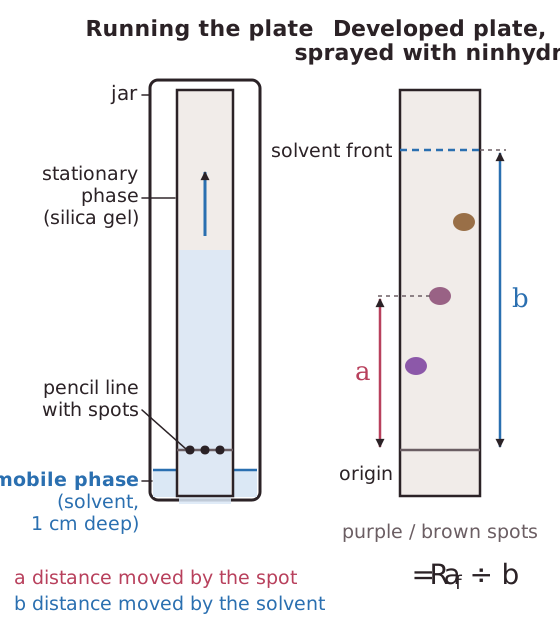
Thin layer chromatography is used to separate components of a mixture.It can also be used as an analytical technique to identify the components of the mixture.It consists of a stationary phase which is a thin layer of silica on a glass or other inert solid surface with one end standing in a jar of organic solvent called the mobile phase. The solvent is about 1cm deep.Before placing the stationary phase in the solvent, a pencil line is drawn just above the surface of the solvent and amino acids are spotted onto the pencil line using a capillary tube.The spots are allowed to dry and then more amino-acid is placed on the spotThe solvent moves up the silica gel dissolving the amino-acids. The amino-acids move different distances up the gel depending on the extent of hydrogen bonding with the silica gel and the solubility in the solvent.When the solvent has reached about 2cm from the top of the plate, the plate is removed from the solvent and the plate is allowed to dry.Amino-acids react with ninhydrin and this is sprayed on the plate in a fume cupboard to produce a purple/brown colour spot and identify the location of each amino-acid spot.