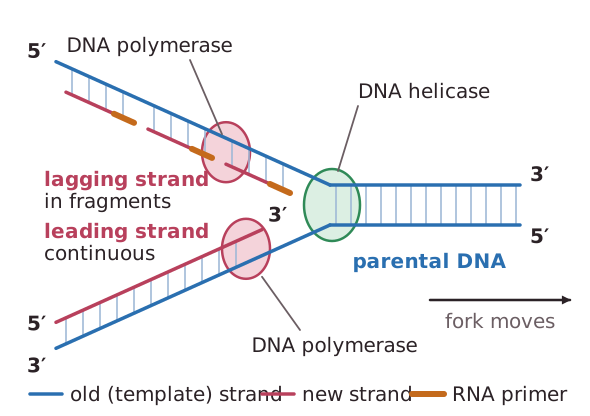
Organisms grow and reproduce by cell division. Before the cell divides, the DNA must be replicated to ensure the amount of DNA in each cell stays the same and each cell has the correct number of chromosomes and the complete genome.DNA replication is semi-conservative. This means that each new copy of DNA is made up of an old strand and a new strand is synthesised on the old strand using the old strand as a template. The new strand is complementary to the old strand.The enzyme DNA helicase separates the two strands and unwinds the helix by breaking the hydrogen bonds between the bases.Free activated nucleotides form hydrogen bonds with the exposed bases.The free nucleotides dATP, dTTP, dCTP and dGTP have three phosphate groups. The free nucleotides bond with their complementary bases. In this way the exposed polynucleotide chains act as a template for the new strands.DNA polymerase enzyme joins the free nucleotides together into a sugar-phosphate backbone.Two of the phosphate groups are hydrolysed providing the energy for the reaction. The remaining phosphate group on carbon-5 is then joined to the OH group on carbon-3 in a condensation reaction to form a phosphodiester bond.The process is semi-conservative because each new DNA molecule contains one old strand and one new strand.