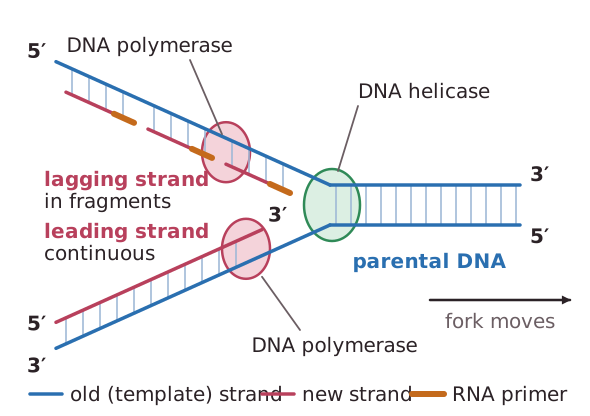
DNA can only be synthesised in the 5' to 3' direction.This means that the DNA polymerase can only add nucleotides to the 3'OH group. So the strand can only grow in one direction.An RNA polymerase synthesises an RNA primer on the DNA template.Then the DNA polymerase add nucleotides to the primer.However, the two strands run in opposite directions. DNA helicase runs along the DNA unwinding it so DNA polymerase is following the replication fork.So DNA polymerase can synthesise DNA continuously on the leading strand but has to synthesise DNA discontinuously in the opposite direction on the lagging strand.This means that DNA is synthesised in sections called Okazaki fragments on the lagging strand.A short RNA primer is laid down on the lagging strand.Small sections of DNA are synthesised using the RNA primers.The RNA primers are then removed and the sections filled in with DNA nucleotides.The Okazaki fragments are then joined by DNA ligase to form a continuous strand.
DNA Replication.