Skip to content

RNA

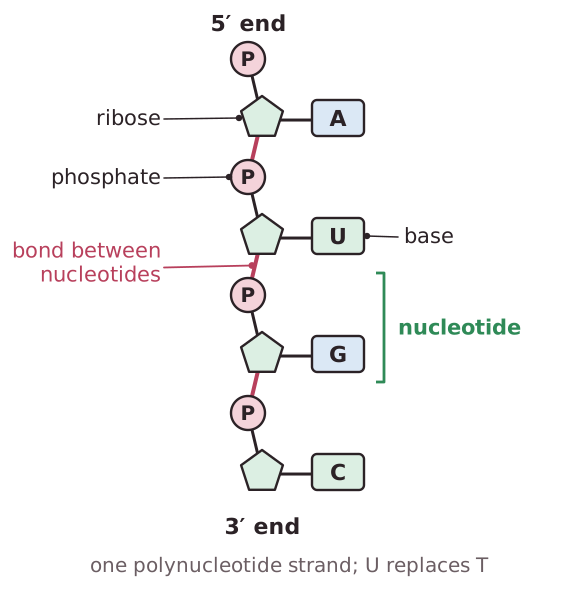
RNA is a polynucleotide.The pentose sugar is ribose and the nucleotides are joined by phosphodiester bonds.RNA contains four nitrogen-containing bases, adenine, cytosine, guanine and uracil.There are three types of RNA: mRNA, rRNA and tRNA. All are involved in protein synthesis.Ribosomal RNA (rRNA) is synthesised in the nucleolus and is a component of ribosomes.Messenger RNA (mRNA) is a copy of a length of DNA called a gene. The mRNA then moves from the nucleus into the cytoplasm to determine the order in which amino-acids are joined together to make proteins.Transfer RNA (tRNA) holds the amino acids in place on a ribosome so a peptide bond can be formed.
Read the text

Read the text and highlight anything you think is important. When you go on, the text is hidden and you answer from memory.

Specification: OCR Biology A (H020), AS-level, 2.1.3 Nucleotides and nucleic acids. Topic: Biological Molecules.

Key terms in this lesson

nucleolus
A spherical structure within the nucleus where ribosomal RNA is made and combined with protein to form ribosomes.
peptide bond
The covalent bond formed between two amino acids by a condensation reaction.
gene
A length of DNA that codes for a specific polypeptide.

More in Biological Molecules

All 63 lessons in Biological Molecules · All OCR AS-level Biology topics