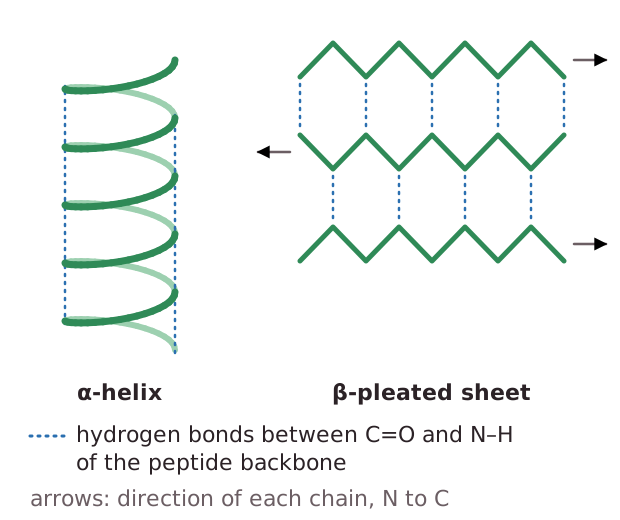
The sequence of nucleotides determines the sequence of amino acids in proteins. The information for the amino acid sequence of the protein is in the DNA in the nucleus but protein synthesis takes place in the cytoplasm.There are different types of RNA. mRNA is a single-stranded copy of the gene to be translated into a protein and is made in the nucleus but leaves the nucleus through nuclear pores and is used in the cytoplasm.mRNA carries the coded information from the nucleus to the cytoplasm. tRNA helps to assemble the amino acids in the correct order.The complete set of genes of an organism is called its genome. The complete set of proteins is called the proteome.Once the polypeptide chain is synthesised it coils and folds into a secondary structure due to hydrogen bonding between the oxygens of the C=O and the hydrogens of the N-H groups of the peptide bonds. Further coiling and folding due to bonds and interactions between the R-groups occurs and the polypeptide chain forms a tertiary structure.The final protein may have a quaternary structure. More than one polypeptide chain joined together by hydrogen, ionic or covalent bonds may be needed to form the functional protein. Other non-protein molecules may also be needed to form the functional protein.