The genetic code is the information contained in DNA that allows functional proteins to be synthesised.The genetic code is a triplet code. A sequence of three bases called a codon codes for one amino acid.A length of DNA that codes for one polypeptide is called a gene.The genetic code is universal. It is the same in all organisms.It is degenerate - there are 20 different amino acids but 43 or 64 different possible codons. 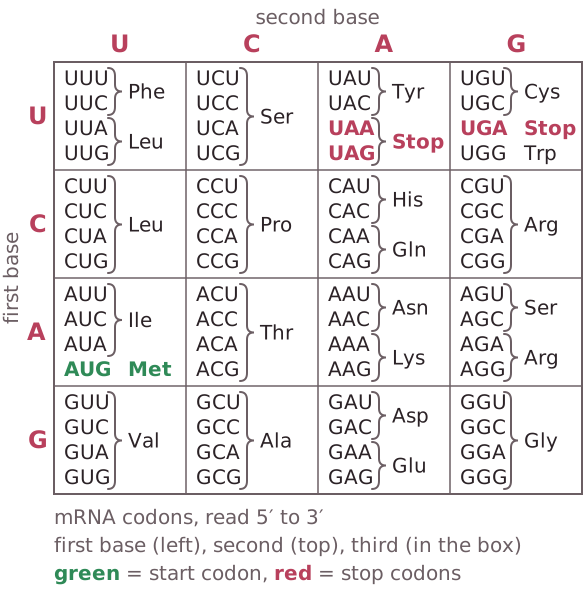
This means that there is more than one codon for some amino acids.The genetic code is non-overlapping and is read in one direction.There is a start codon AUG(for methionine) and three stop codons UAA, UAG, and UGA in eukaryotes that do not code for any amino acid.