Inhalation (inspiration) is an active process: it needs muscle contraction, and therefore energy from ATP.During inhalation:• the external intercostal muscles contract and the internal intercostal muscles relax
• this pulls the ribcage upwards and outwards
• the diaphragm contracts and flattens, moving downwards from its relaxed dome shape
• both movements increase the volume of the thoracic cavity
• the pressure inside the thorax and lungs therefore falls below atmospheric pressure
• air flows into the lungs down this pressure gradient, through the nose or mouth, trachea, bronchi and bronchioles to the alveoliThe lungs are pulled outwards with the chest wall because the two pleural membranes are held together by a thin film of pleural fluid. As the lungs expand, the elastic fibres in the alveolar walls are stretched, storing energy that will help with exhalation.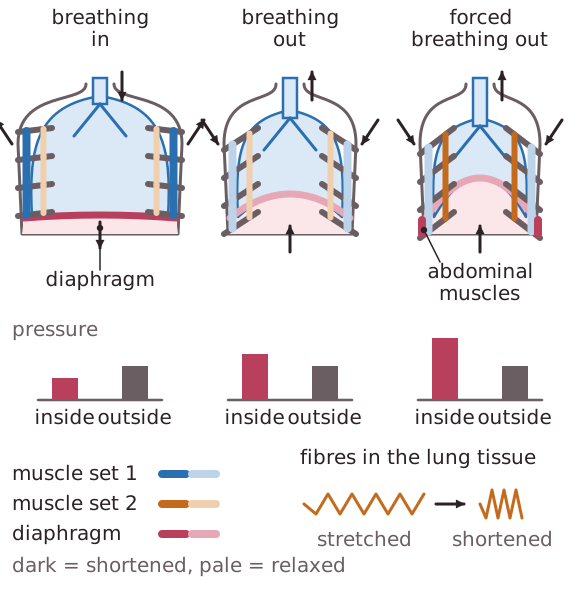 The flow of air stops when the pressure in the lungs becomes equal to atmospheric pressure.During exercise, inhalation is deeper: the external intercostals and diaphragm contract more strongly, and accessory muscles in the neck can help lift the ribcage further. This gives a bigger increase in thoracic volume, a larger fall in pressure and so a larger volume of air drawn in with each breath.
• this pulls the ribcage upwards and outwards
• the diaphragm contracts and flattens, moving downwards from its relaxed dome shape
• both movements increase the volume of the thoracic cavity
• the pressure inside the thorax and lungs therefore falls below atmospheric pressure
• air flows into the lungs down this pressure gradient, through the nose or mouth, trachea, bronchi and bronchioles to the alveoliThe lungs are pulled outwards with the chest wall because the two pleural membranes are held together by a thin film of pleural fluid. As the lungs expand, the elastic fibres in the alveolar walls are stretched, storing energy that will help with exhalation.
The flow of air stops when the pressure in the lungs becomes equal to atmospheric pressure.During exercise, inhalation is deeper: the external intercostals and diaphragm contract more strongly, and accessory muscles in the neck can help lift the ribcage further. This gives a bigger increase in thoracic volume, a larger fall in pressure and so a larger volume of air drawn in with each breath.