Large Surface Area, Short Diffusion Distance, Steep Concentration GradientThese are the three key adaptations that make the human lungs so efficient at gas exchange.Large surface area. The lungs contain hundreds of millions of alveoli, which together give a total surface area of about 70 m2. Each alveolus is covered by many capillaries, so the area in contact with blood is also very large.Short diffusion distance. The alveolar wall is made of thin, flat squamous epithelium cells, and the capillary wall is a single layer of endothelium cells, so gases cross only two thin cells.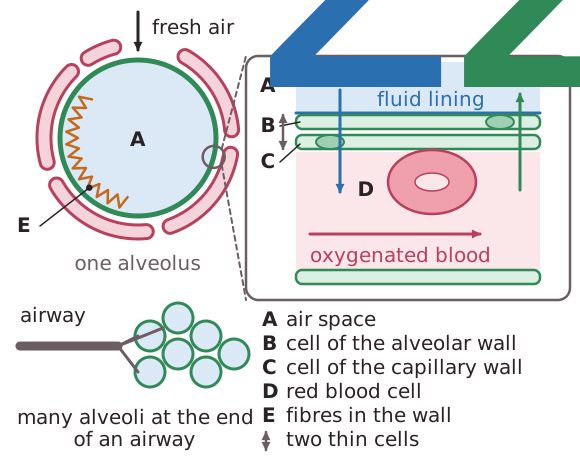 The capillaries are so narrow that red blood cells are squeezed against the capillary wall, which reduces the diffusion distance further and slows the cells down, giving more time for diffusion.Steep concentration gradient. Ventilation (breathing) constantly brings in fresh air, and constant blood flow carries oxygenated blood away. Together these maintain a steep concentration gradient for both oxygen and carbon dioxide.Other adaptations:
• Elastic fibres in the alveolar walls stretch when we breathe in and recoil to help push air out.
• The inner surface is moist, so gases dissolve before diffusing.
• Surfactant, a phospholipid-rich fluid lining the alveoli, lowers surface tension so the alveoli do not collapse when we breathe out.Diseases show why these features matter. In emphysema, the alveolar walls break down, so the surface area falls and less oxygen diffuses into the blood.
The capillaries are so narrow that red blood cells are squeezed against the capillary wall, which reduces the diffusion distance further and slows the cells down, giving more time for diffusion.Steep concentration gradient. Ventilation (breathing) constantly brings in fresh air, and constant blood flow carries oxygenated blood away. Together these maintain a steep concentration gradient for both oxygen and carbon dioxide.Other adaptations:• Elastic fibres in the alveolar walls stretch when we breathe in and recoil to help push air out.
• The inner surface is moist, so gases dissolve before diffusing.
• Surfactant, a phospholipid-rich fluid lining the alveoli, lowers surface tension so the alveoli do not collapse when we breathe out.Diseases show why these features matter. In emphysema, the alveolar walls break down, so the surface area falls and less oxygen diffuses into the blood.