Every breath brings dust, pollen, bacteria and viruses into the airways. The gas exchange system has several defences that stop these reaching and damaging the delicate alveoli.• Nose: hairs filter out large particles, and the moist, well supplied lining warms and moistens incoming air so it does not dry out or cool the alveoli.
• Goblet cells in the epithelium of the trachea and bronchi secrete mucus. The sticky mucus traps particles and pathogens.
• Ciliated epithelial cells have hair-like cilia that beat in a coordinated wave, moving the mucus up and out of the airways to the throat, where it is swallowed. Stomach acid then destroys most of the trapped pathogens. This is sometimes called the mucociliary escalator.
• Mucous glands beneath the epithelium add more mucus.
• Macrophages, phagocytic white blood cells in the alveoli, engulf and digest any particles or bacteria that get past these defences.
• Coughing and sneezing are reflexes that forcibly expel irritants.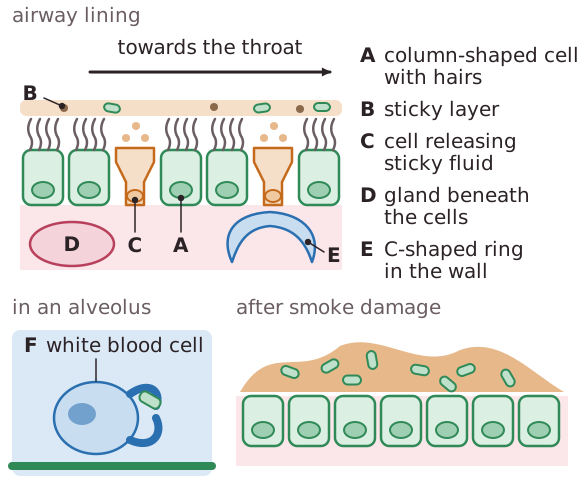 The airways are also kept open by cartilage (C-shaped rings in the trachea, irregular plates in the bronchi), so they do not collapse when pressure falls during inhalation. Smooth muscle in the walls of the bronchioles can contract to narrow them, reducing the entry of irritants.Some substances damage these defences. For example, tar in cigarette smoke paralyses and destroys cilia and stimulates goblet cells to produce more mucus. Mucus then builds up, is removed mainly by coughing, and bacteria can multiply in it, making lung infections more likely.
• Goblet cells in the epithelium of the trachea and bronchi secrete mucus. The sticky mucus traps particles and pathogens.
• Ciliated epithelial cells have hair-like cilia that beat in a coordinated wave, moving the mucus up and out of the airways to the throat, where it is swallowed. Stomach acid then destroys most of the trapped pathogens. This is sometimes called the mucociliary escalator.
• Mucous glands beneath the epithelium add more mucus.
• Macrophages, phagocytic white blood cells in the alveoli, engulf and digest any particles or bacteria that get past these defences.
• Coughing and sneezing are reflexes that forcibly expel irritants.
The airways are also kept open by cartilage (C-shaped rings in the trachea, irregular plates in the bronchi), so they do not collapse when pressure falls during inhalation. Smooth muscle in the walls of the bronchioles can contract to narrow them, reducing the entry of irritants.Some substances damage these defences. For example, tar in cigarette smoke paralyses and destroys cilia and stimulates goblet cells to produce more mucus. Mucus then builds up, is removed mainly by coughing, and bacteria can multiply in it, making lung infections more likely.