The human gas exchange system is inside the chest cavity (thorax). It carries air from outside the body to the lungs, where gas exchange takes place in the alveoli.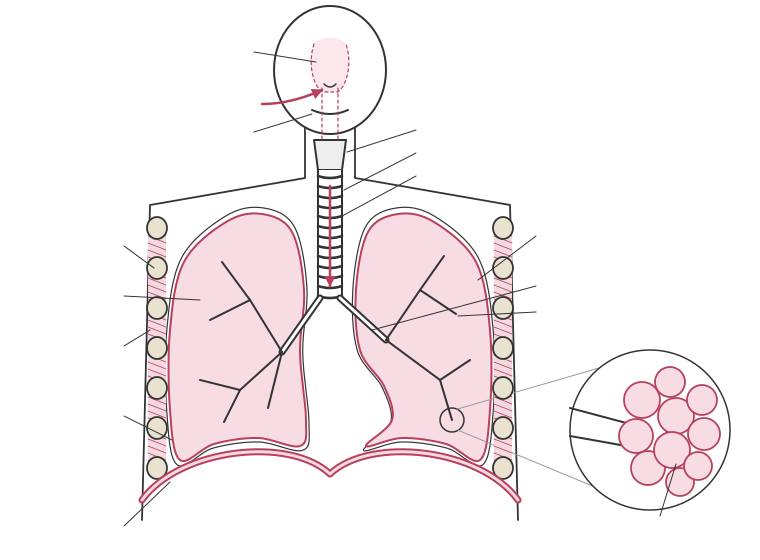
1. Nasal cavity: air is warmed, moistened and filtered by hairs and mucus.
2. Trachea (windpipe): a wide tube held open by C-shaped rings of cartilage, so it does not collapse when air pressure falls during breathing in. The rings are incomplete at the back, where the trachea lies against the oesophagus, so the oesophagus can expand when food is swallowed.
3. Bronchi: the trachea divides into two bronchi, one to each lung. They also have cartilage for support.
4. Bronchioles: the bronchi branch into many smaller tubes. Their walls contain smooth muscle, which can contract or relax to change the diameter and control air flow. The smallest bronchioles have no cartilage.
5. Alveoli: tiny air sacs at the ends of the bronchioles, where oxygen and carbon dioxide are exchanged with the blood.The trachea and bronchi are lined with ciliated epithelium containing goblet cells. Goblet cells secrete mucus, which traps dust and microorganisms, and the cilia beat to move the mucus up to the throat, where it is swallowed.The lungs are protected by the ribcage. The intercostal muscles between the ribs and the diaphragm, a sheet of muscle below the lungs, carry out ventilation. Each lung is surrounded by pleural membranes, with pleural fluid between them that reduces friction as the lungs move.