Insects are small, so they have a large surface area to volume ratio. However, they cannot exchange gases across their body surface. Their body is covered by an exoskeleton with a waxy cuticle that is almost impermeable to water and gases. This waterproofing is essential, because a small land animal with a large surface area would otherwise lose water very quickly by evaporation.Insects therefore face a trade-off: they need to exchange oxygen and carbon dioxide with the air, but every surface that is permeable to gases is also a surface through which water vapour can escape.Their solution is an internal system of air-filled tubes, the tracheal system, which opens to the outside through small pores called spiracles along the sides of the thorax and abdomen. Air enters through the spiracles and oxygen travels through the tubes directly to the respiring cells. Carbon dioxide leaves by the reverse route.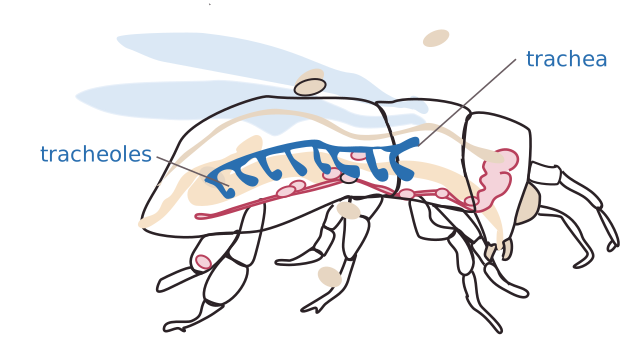 Important features of insect gas exchange:• oxygen is delivered straight to the tissues in air, so the insect's blood (haemolymph) does not carry oxygen and has no haemoglobin-like pigment for this purpose
• gases move mainly by diffusion, which is fast in air
• spiracles can be opened and closed by muscular valves; they close when the insect is inactive to reduce water loss, and open when more oxygen is needed or carbon dioxide builds up
• hairs around many spiracles trap a layer of moist air, which reduces evaporation furtherBecause diffusion is only efficient over short distances, this system limits how large insects can grow.
Important features of insect gas exchange:• oxygen is delivered straight to the tissues in air, so the insect's blood (haemolymph) does not carry oxygen and has no haemoglobin-like pigment for this purpose• gases move mainly by diffusion, which is fast in air
• spiracles can be opened and closed by muscular valves; they close when the insect is inactive to reduce water loss, and open when more oxygen is needed or carbon dioxide builds up
• hairs around many spiracles trap a layer of moist air, which reduces evaporation furtherBecause diffusion is only efficient over short distances, this system limits how large insects can grow.