Exhalation (expiration) at rest is mainly a passive process: it happens when the muscles used for inhalation relax, so little extra energy is needed.During normal exhalation:• the external intercostal muscles relax, so the ribcage moves downwards and inwards under gravity
• the diaphragm relaxes and is pushed back up into its dome shape by the abdominal organs
• the stretched elastic fibres in the alveolar walls recoil, helping to push air out
• the volume of the thorax decreases
• the pressure in the lungs rises above atmospheric pressure, so air flows out of the lungsForced exhalation, for example during exercise, coughing or blowing, is active. The internal intercostal muscles contract, pulling the ribcage down and in more strongly, while the external intercostals relax. The abdominal muscles also contract, pushing the abdominal organs and the diaphragm upwards. This reduces the thoracic volume further and more quickly, so the pressure rises more and air is expelled faster.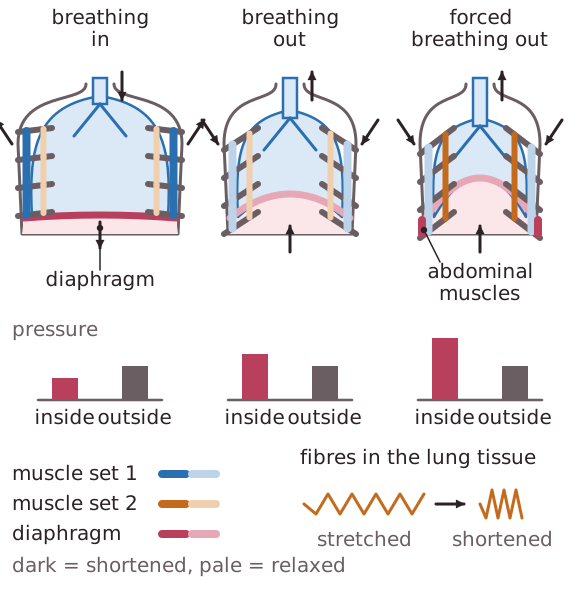 The internal and external intercostal muscles are an antagonistic pair: when one contracts, the other relaxes.Even after the deepest exhalation some air remains in the lungs (the residual volume), because the airways are held open by cartilage and the alveoli do not fully collapse. This stops the alveolar walls sticking together.
• the diaphragm relaxes and is pushed back up into its dome shape by the abdominal organs
• the stretched elastic fibres in the alveolar walls recoil, helping to push air out
• the volume of the thorax decreases
• the pressure in the lungs rises above atmospheric pressure, so air flows out of the lungsForced exhalation, for example during exercise, coughing or blowing, is active. The internal intercostal muscles contract, pulling the ribcage down and in more strongly, while the external intercostals relax. The abdominal muscles also contract, pushing the abdominal organs and the diaphragm upwards. This reduces the thoracic volume further and more quickly, so the pressure rises more and air is expelled faster.
The internal and external intercostal muscles are an antagonistic pair: when one contracts, the other relaxes.Even after the deepest exhalation some air remains in the lungs (the residual volume), because the airways are held open by cartilage and the alveoli do not fully collapse. This stops the alveolar walls sticking together.