Lipids are detected with the emulsion test. It relies on the fact that lipids dissolve in ethanol but not in water.Method:
1. Add about 2 cm3 of ethanol to the sample in a clean, dry test tube (crush a solid sample first).
2. Shake thoroughly so that any lipid dissolves in the ethanol.
3. Pour the ethanol solution into a second test tube containing about 2 cm3 of water, and shake gently.Result: if lipid is present, a cloudy white emulsion forms. If there is no lipid, the mixture stays clear.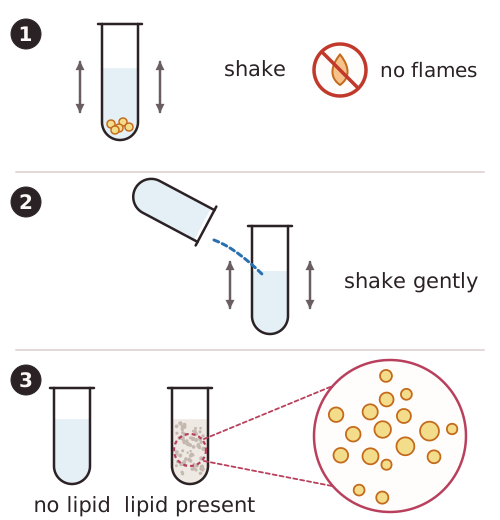
clear → cloudy white emulsion = lipid present Why it works: when the ethanol is mixed with water, the lipid can no longer stay in solution because it is insoluble in water. It comes out as tiny droplets spread throughout the liquid. These droplets scatter light, which makes the liquid look milky.Points of good practice:
• Use clean, dry tubes, because water in the first tube would stop the lipid dissolving.
• Wear eye protection and keep ethanol away from flames, as it is flammable.
• Run a control with ethanol and water only, to show that a clear result is what you get without lipid.The test is qualitative: it shows whether lipid is present, not how much.Worked example: milk gives a cloudy white emulsion, but a glucose solution stays clear. So milk contains lipid and the glucose solution does not.
1. Add about 2 cm3 of ethanol to the sample in a clean, dry test tube (crush a solid sample first).
2. Shake thoroughly so that any lipid dissolves in the ethanol.
3. Pour the ethanol solution into a second test tube containing about 2 cm3 of water, and shake gently.Result: if lipid is present, a cloudy white emulsion forms. If there is no lipid, the mixture stays clear.
• Use clean, dry tubes, because water in the first tube would stop the lipid dissolving.
• Wear eye protection and keep ethanol away from flames, as it is flammable.
• Run a control with ethanol and water only, to show that a clear result is what you get without lipid.The test is qualitative: it shows whether lipid is present, not how much.Worked example: milk gives a cloudy white emulsion, but a glucose solution stays clear. So milk contains lipid and the glucose solution does not.