Amino acids are the monomers of proteins. All amino acids have the same basic structure: a central carbon atom (the α-carbon) bonded to four groups:• an amino group, –NH2
• a carboxyl group, –COOH
• a hydrogen atom
• a variable side chain, the R group
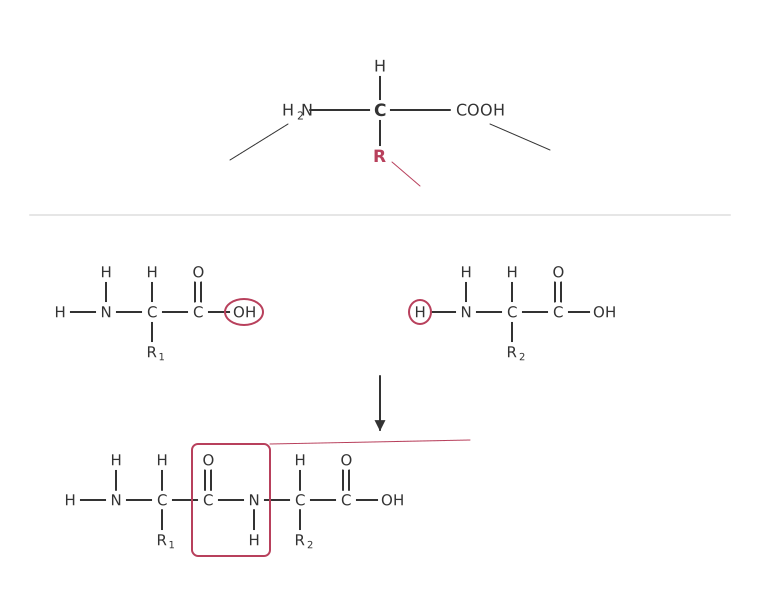
There are 20 different amino acids in proteins, and they differ only in their R groups. The simplest is glycine, where R is just a hydrogen atom. Some R groups are non-polar, some polar, some carry a charge, and cysteine's R group contains sulfur. The properties of the R groups decide how a protein folds.Peptide bonds. Two amino acids join in a condensation reaction. The –OH from the carboxyl group of one amino acid and an –H from the amino group of the other are removed as water, and a peptide bond (–CO–NH–) forms between the carbon and the nitrogen. Two amino acids make a dipeptide; many make a polypeptide.A polypeptide has a free amino group at one end and a free carboxyl group at the other. Peptide bonds are broken by hydrolysis, catalysed by protease enzymes.Worked example: a polypeptide of 150 amino acids contains 150 − 1 = 149 peptide bonds, so 149 water molecules were released when it formed.Since 20 different amino acids can be joined in any order, there are 203 = 8000 possible tripeptides, and an almost unlimited number of proteins.
• a carboxyl group, –COOH
• a hydrogen atom
• a variable side chain, the R group