A phospholipid is similar to a triglyceride, except that one of the three fatty acids is replaced by a phosphate group. So a phospholipid is made of glycerol, two fatty acids joined by ester bonds, and a phosphate group. Often another small polar group, such as choline, is attached to the phosphate.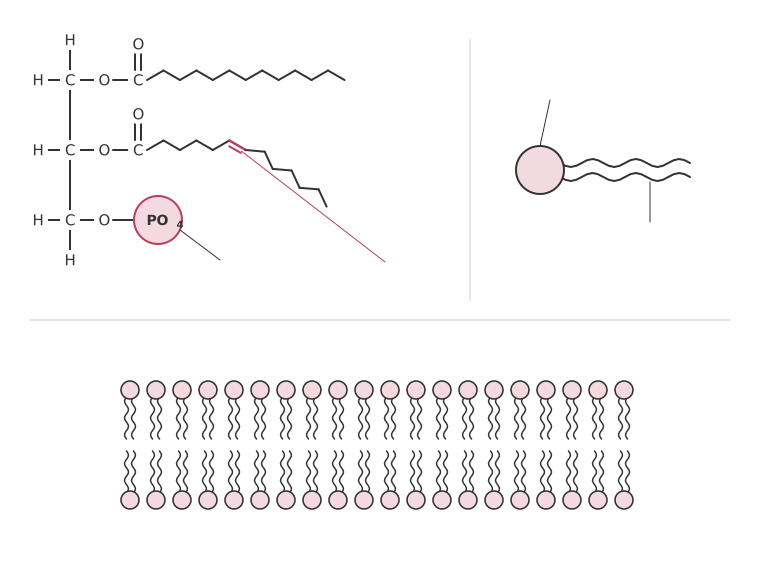
• The two fatty acid tails are non-polar hydrocarbon chains, so they are hydrophobic: they are repelled by water and attracted to each other.A molecule with a hydrophilic part and a hydrophobic part is described as amphipathic.Behaviour in water. Because of this, phospholipids arrange themselves so that the heads are in contact with water and the tails are hidden from it. On the surface of water they form a single layer (a monolayer) with the tails pointing up into the air. Surrounded by water they form a bilayer: two layers with the tails facing inwards and the heads facing the water on each side. They can also form small spheres called micelles.This bilayer is the basis of every cell membrane. Because the middle of the bilayer is hydrophobic, it acts as a barrier to ions and polar molecules.If a fatty acid tail is unsaturated, its kink stops the phospholipids packing tightly, which makes a membrane more fluid.
• The two fatty acid tails are non-polar hydrocarbon chains, so they are hydrophobic: they are repelled by water and attracted to each other.A molecule with a hydrophilic part and a hydrophobic part is described as amphipathic.Behaviour in water. Because of this, phospholipids arrange themselves so that the heads are in contact with water and the tails are hidden from it. On the surface of water they form a single layer (a monolayer) with the tails pointing up into the air. Surrounded by water they form a bilayer: two layers with the tails facing inwards and the heads facing the water on each side. They can also form small spheres called micelles.This bilayer is the basis of every cell membrane. Because the middle of the bilayer is hydrophobic, it acts as a barrier to ions and polar molecules.If a fatty acid tail is unsaturated, its kink stops the phospholipids packing tightly, which makes a membrane more fluid.