Skip to content

Viruses

Viruses are non-living particles made up of nucleic acid (RNA or DNA) enclosed in a protein coat or capsid.Some viruses such as the human immunodeficiency (HIV) virus also have a lipid envelope.There are attachment proteins on the surface of the virus which allow the virus to identify, attach and gain entry into specific cells.For example the HIV gp120 attachment glycoproteins attach to CD4 molecules on the surface of T-helper cells and gain entry into T-helper cells.Viruses infect all cells including bacteria. Viruses that infect bacteria are called bacteriophages.Viruses are much smaller than bacterial cells. They are about 20-300nm in diameter.
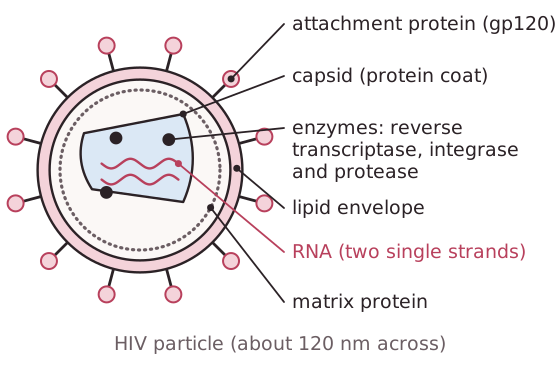
HIV virus infects human T-helper cells.1. Attachment proteins attach to receptors on helper T cell2. Nucleic acid/RNA enters cell.3. Reverse transcriptase converts RNA to DNA.4. Viral protein for the capsid and enzymes are produced.5. Virus particles are assembled and released from the cell.

Read the text

Read the text and highlight anything you think is important. When you go on, the text is hidden and you answer from memory.

Specification: AQA Biology (7401), AS-level, 3.2.1.2 Structure of prokaryotic cells and of viruses. Topic: Cell Structure.

Key terms in this lesson

cell cycle
The regular sequence of events in the life of a dividing cell, consisting of interphase, mitosis and cytokinesis.
T-lymphocyte
A type of white blood cell, matured in the thymus gland, responsible for the cell-mediated immune response.

More in Cell Structure

All 26 lessons in Cell Structure · All AQA AS-level Biology topics