 BRAINCAKE
Tissues
A tissue is a group of similar cells working together to carry out a specific function.
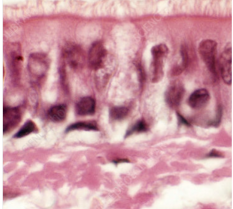
Epithelial tissue are layers of cells that line the inner surface of organs.
Some epithelial flat, thin squamous epithelium such are those which line the blood vessels and alveoli. These are adapted for efficient diffusion as they provide a short diffusion path.
Sign in free to see the rest of this lesson, the R.E.C.I.P.E. recall steps and the quiz
BrainCake is free. Make an account in seconds and pick up where this page stops.
Key terms in this lesson
- diffusion
- The net passive movement of molecules or ions from a region of higher concentration to a region of lower concentration, down a concentration gradient.
- alveolus
- A tiny, thin-walled air sac in the lungs, surrounded by capillaries, that is the site of gas exchange.
- xylem
- Plant vascular tissue, made of dead, lignified tubular cells, that transports water and mineral ions from the roots to the leaves.
- phloem
- Plant vascular tissue, made of sieve tube elements and companion cells, that transports organic solutes such as sucrose around the plant.
More in Cell Structure
- Cell Wall
- Vacuoles
- Cell Structure and Function
- Cell Specialisation
- Organs
- Organ Systems
- Prokaryotic Cell Structure
- Prokaryotic vs Eukaryotic Cells
All 26 lessons in Cell Structure · All AQA AS-level Biology topics