 BRAINCAKE
Prokaryotic Cell Structure
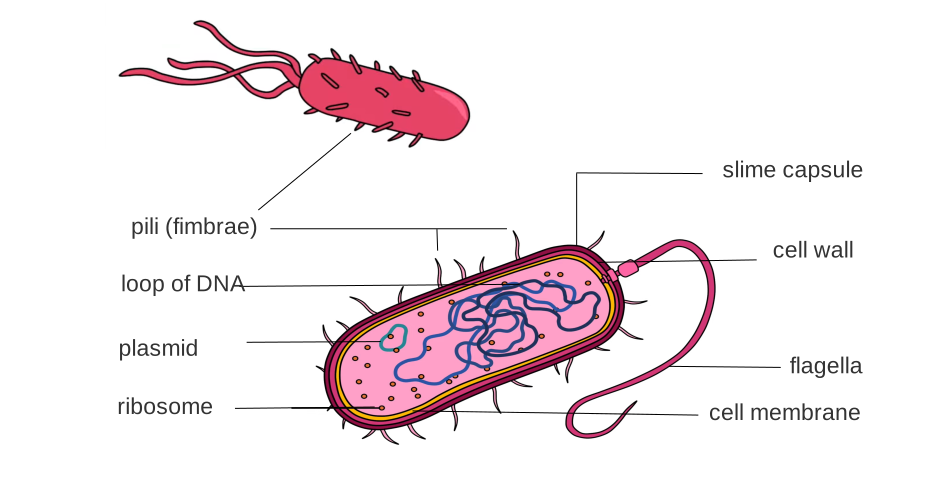
Prokaryotic organisms are unicellular and the cells have a simple structure. They have no membrane-bound organelles and their genetic material is a single, compact loop of supercoiled DNA called a chromosome.
The genes on the chromosome are often grouped into operons, a cluster of genes that are transcribed together to give a single messenger RNA (mRNA) molecule. This allows a group of proteins to be synthesised at the same time.
Sign in free to see the rest of this lesson, the R.E.C.I.P.E. recall steps and the quiz
BrainCake is free. Make an account in seconds and pick up where this page stops.
Key terms in this lesson
- ribosome
- A small organelle, made of RNA and protein, that is the site of protein synthesis.
- eukaryotic cell
- A cell that has a nucleus and membrane-bound organelles.
- gene
- A length of DNA that codes for a polypeptide or a functional RNA molecule, at a specific locus on a chromosome.
More in Cell Structure
- Vacuoles
- Cell Structure and Function
- Cell Specialisation
- Tissues
- Organs
- Organ Systems
- Prokaryotic vs Eukaryotic Cells
- Viruses
All 26 lessons in Cell Structure · All AQA AS-level Biology topics