Recombinant DNA is DNA made by combining DNA from two different organisms. It is the first step in genetic modification.Obtaining the gene
• Restriction enzymes (restriction endonucleases) cut DNA at specific base sequences called recognition sites. Many make a staggered cut, leaving short single-stranded overhangs called sticky ends. For example, EcoRI cuts between G and A in the sequence GAATTC.
• Reverse transcriptase makes complementary DNA (cDNA) from the mRNA of the gene. Cells that make a lot of the protein contain a lot of its mRNA, which makes this easier. The cDNA has no introns, which is important because bacteria cannot remove introns.
• The gene can also be made by an automated DNA synthesiser from a known sequence, and copied many times by PCR.Inserting the gene into a plasmid
1. A plasmid (small circle of bacterial DNA) is cut open with the same restriction enzyme, so its sticky ends are complementary to those of the gene.
2. The gene and plasmid are mixed. Complementary sticky ends pair up by hydrogen bonding between bases.
3. DNA ligase joins the sugar-phosphate backbones by forming phosphodiester bonds.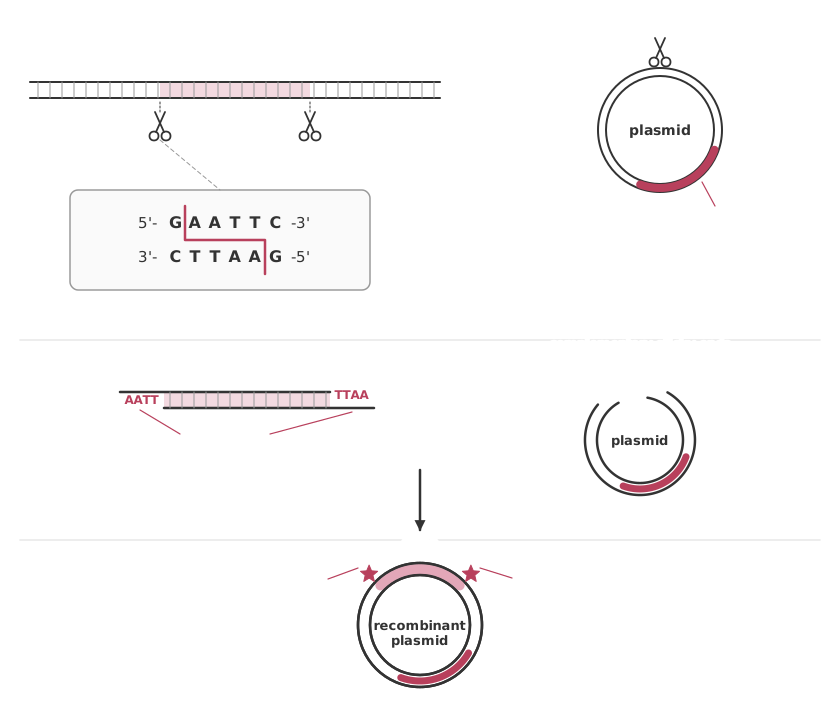
• Restriction enzymes (restriction endonucleases) cut DNA at specific base sequences called recognition sites. Many make a staggered cut, leaving short single-stranded overhangs called sticky ends. For example, EcoRI cuts between G and A in the sequence GAATTC.
• Reverse transcriptase makes complementary DNA (cDNA) from the mRNA of the gene. Cells that make a lot of the protein contain a lot of its mRNA, which makes this easier. The cDNA has no introns, which is important because bacteria cannot remove introns.
• The gene can also be made by an automated DNA synthesiser from a known sequence, and copied many times by PCR.Inserting the gene into a plasmid
1. A plasmid (small circle of bacterial DNA) is cut open with the same restriction enzyme, so its sticky ends are complementary to those of the gene.
2. The gene and plasmid are mixed. Complementary sticky ends pair up by hydrogen bonding between bases.
3. DNA ligase joins the sugar-phosphate backbones by forming phosphodiester bonds.