Microinjection puts DNA directly into a cell using a very fine glass micropipette, under a microscope. It is the classic method for producing transgenic animals.Method for a transgenic animal
1. Eggs are collected from a female and fertilised in vitro.
2. A fertilised egg is held still by gentle suction from a blunt holding pipette.
3. The micropipette, with a tip less than 1 µm wide, is pushed into the egg and a tiny volume of DNA solution is injected, usually into the male pronucleus (the nucleus from the sperm, before it fuses with the egg nucleus), because it is larger and easier to target.
4. The injected eggs are cultured briefly, then implanted into a surrogate mother.
5. Offspring are tested for the new gene, for example using PCR.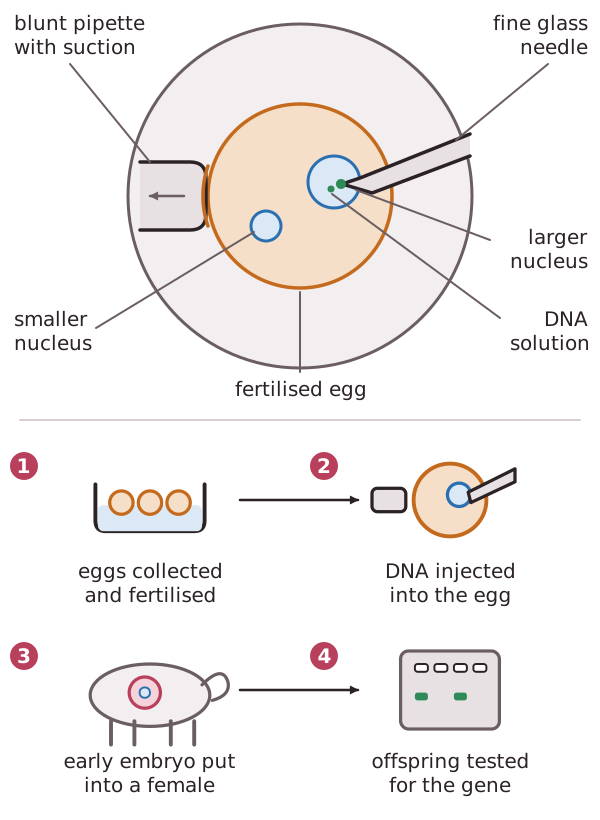 Because the DNA is injected at the one-cell stage, if it integrates immediately, every cell of the animal, including its gametes, contains the gene, so it can be passed on to offspring.Disadvantages
• It is slow and needs great skill, because only one cell can be injected at a time.
• The DNA integrates in only a small proportion of injected eggs, and many eggs do not survive injection.
• The gene inserts at a random position, so its expression varies and it may disrupt another gene.Advantages
• No vector is needed, so any length of DNA can be used.
• It works in many species, including mice, sheep, goats and fish.
1. Eggs are collected from a female and fertilised in vitro.
2. A fertilised egg is held still by gentle suction from a blunt holding pipette.
3. The micropipette, with a tip less than 1 µm wide, is pushed into the egg and a tiny volume of DNA solution is injected, usually into the male pronucleus (the nucleus from the sperm, before it fuses with the egg nucleus), because it is larger and easier to target.
4. The injected eggs are cultured briefly, then implanted into a surrogate mother.
5. Offspring are tested for the new gene, for example using PCR.
Because the DNA is injected at the one-cell stage, if it integrates immediately, every cell of the animal, including its gametes, contains the gene, so it can be passed on to offspring.Disadvantages• It is slow and needs great skill, because only one cell can be injected at a time.
• The DNA integrates in only a small proportion of injected eggs, and many eggs do not survive injection.
• The gene inserts at a random position, so its expression varies and it may disrupt another gene.Advantages
• No vector is needed, so any length of DNA can be used.
• It works in many species, including mice, sheep, goats and fish.