Plants can be cloned to produce many offspring that are genetically identical to the parent. This is useful for multiplying a valuable or genetically modified plant quickly.Micropropagation (tissue culture)
1. A small piece of tissue, called an explant, is cut from the parent plant, often from a meristem such as a shoot tip.
2. The explant is sterilised, for example with dilute bleach, to kill microorganisms on its surface.
3. It is placed on a sterile agar medium containing glucose, amino acids, minerals and plant hormones (auxins and cytokinins).
4. The cells divide by mitosis to form an undifferentiated mass called a callus.
5. The callus is divided into many small pieces and moved to media with different hormone ratios. A high ratio of cytokinin to auxin stimulates shoots, and a high ratio of auxin to cytokinin stimulates roots.
6. The plantlets are moved to a greenhouse and gradually hardened off.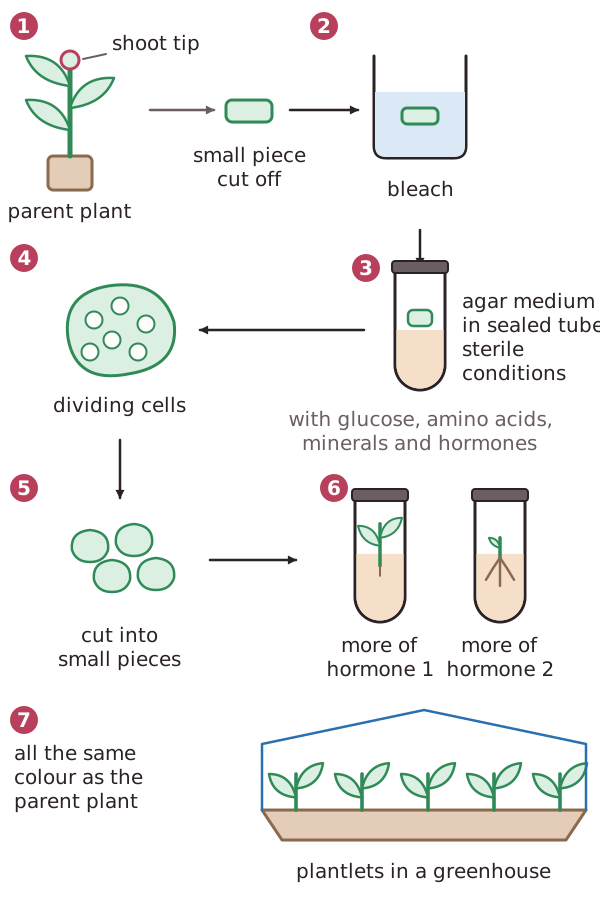 All stages must use aseptic technique, because microorganisms grow rapidly on the nutrient medium and would kill the plant tissue.Advantages
• Large numbers of identical plants are produced quickly, all year round, in a small space.
• Plants grown from meristems can be free of viruses.
• It is a way of growing whole GM plants from single transformed cells.Disadvantages
• It is expensive and needs skilled workers.
• The clones have no genetic variation, so a new disease or pest could destroy the whole crop.
1. A small piece of tissue, called an explant, is cut from the parent plant, often from a meristem such as a shoot tip.
2. The explant is sterilised, for example with dilute bleach, to kill microorganisms on its surface.
3. It is placed on a sterile agar medium containing glucose, amino acids, minerals and plant hormones (auxins and cytokinins).
4. The cells divide by mitosis to form an undifferentiated mass called a callus.
5. The callus is divided into many small pieces and moved to media with different hormone ratios. A high ratio of cytokinin to auxin stimulates shoots, and a high ratio of auxin to cytokinin stimulates roots.
6. The plantlets are moved to a greenhouse and gradually hardened off.
All stages must use aseptic technique, because microorganisms grow rapidly on the nutrient medium and would kill the plant tissue.Advantages• Large numbers of identical plants are produced quickly, all year round, in a small space.
• Plants grown from meristems can be free of viruses.
• It is a way of growing whole GM plants from single transformed cells.Disadvantages
• It is expensive and needs skilled workers.
• The clones have no genetic variation, so a new disease or pest could destroy the whole crop.