A gene gun fires DNA directly into cells. The method is also called biolistics (biological ballistics) or particle bombardment.How it works
1. Copies of the DNA to be inserted are coated onto microscopic particles of gold or tungsten, about 1 µm across. These metals are dense and unreactive.
2. The particles are loaded into the gun and fired at the target tissue at high speed, driven by a burst of high-pressure helium gas.
3. The particles pass through the cell wall and cell surface membrane. In some cells the DNA reaches the nucleus and becomes incorporated into a chromosome.
4. Cells are then grown on a medium containing an antibiotic or herbicide to select the transformed cells, which carry a matching resistance marker gene.
5. Transformed cells are grown into whole plants by tissue culture.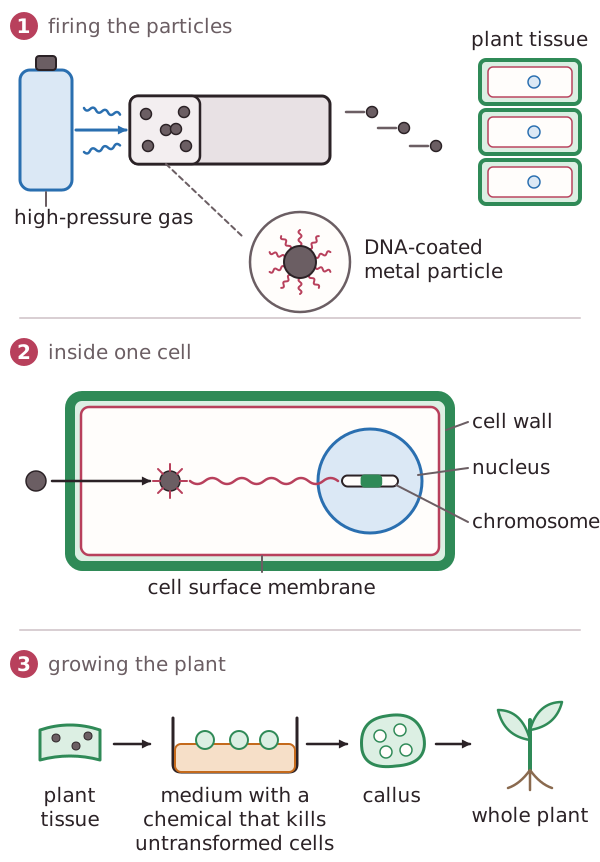 Advantages
• It works for almost any cell type, including monocot cereal crops such as wheat, rice and maize, which are not easily infected by Agrobacterium.
• It can deliver DNA into chloroplasts as well as the nucleus.
• No biological vector is needed.Disadvantages
• Many cells are damaged by the particles.
• The DNA inserts at a random position, which may disrupt other genes, and several copies may insert, causing unstable expression.
• Only a small proportion of cells are transformed.Gene guns are also used to deliver DNA vaccines into skin cells in animals.
1. Copies of the DNA to be inserted are coated onto microscopic particles of gold or tungsten, about 1 µm across. These metals are dense and unreactive.
2. The particles are loaded into the gun and fired at the target tissue at high speed, driven by a burst of high-pressure helium gas.
3. The particles pass through the cell wall and cell surface membrane. In some cells the DNA reaches the nucleus and becomes incorporated into a chromosome.
4. Cells are then grown on a medium containing an antibiotic or herbicide to select the transformed cells, which carry a matching resistance marker gene.
5. Transformed cells are grown into whole plants by tissue culture.
Advantages• It works for almost any cell type, including monocot cereal crops such as wheat, rice and maize, which are not easily infected by Agrobacterium.
• It can deliver DNA into chloroplasts as well as the nucleus.
• No biological vector is needed.Disadvantages
• Many cells are damaged by the particles.
• The DNA inserts at a random position, which may disrupt other genes, and several copies may insert, causing unstable expression.
• Only a small proportion of cells are transformed.Gene guns are also used to deliver DNA vaccines into skin cells in animals.