Positive feedback is a mechanism in which a change triggers a response that increases the change, so the variable moves even further from its starting value. The response amplifies the stimulus.Because it pushes a variable away from the set point, positive feedback does not maintain homeostasis. It is useful when a process needs to happen quickly and be completed, and the loop is broken when the process ends.Example: childbirthAs the baby's head presses on the cervix, stretch receptors send nerve impulses to the hypothalamus, and the posterior pituitary releases more oxytocin. Oxytocin makes the muscle of the uterus wall contract more strongly, which pushes the baby harder against the cervix, which causes even more oxytocin to be released. Contractions become stronger and more frequent until the baby is born. Once the baby is delivered, the stretching stops and the loop ends.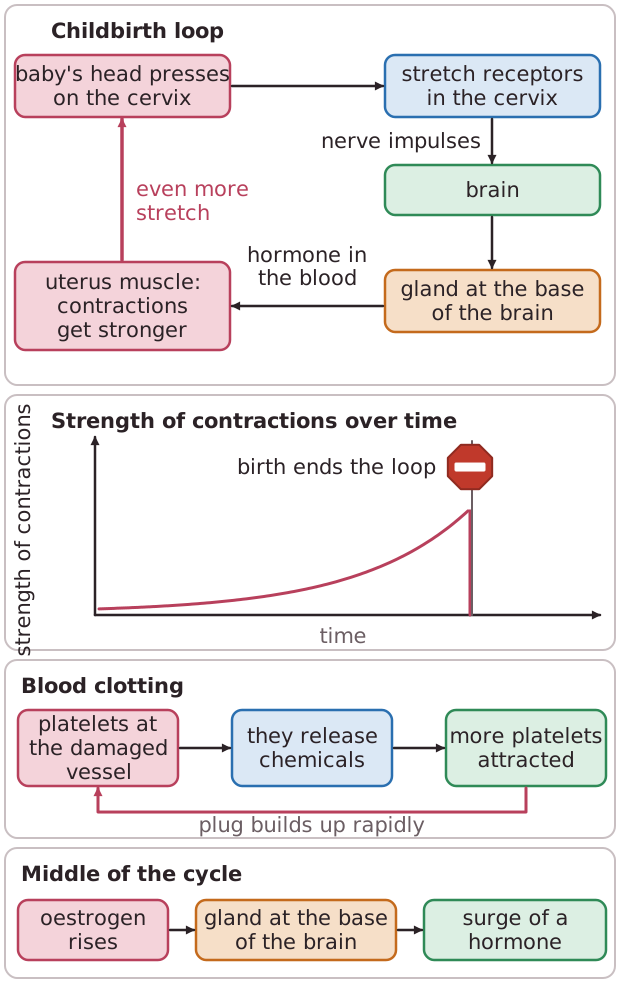 Example: blood clottingPlatelets at a damaged blood vessel release chemicals that attract and activate more platelets, so a plug builds up rapidly.Example: the menstrual cycleRising oestrogen in the middle of the cycle stimulates the anterior pituitary to release more LH, producing the LH surge that triggers ovulation.Positive feedback can also be harmful when a homeostatic system is overwhelmed. For example, in severe hypothermia a fall in body temperature slows metabolism, so less heat is produced, and temperature falls further.