Peptide hormones, and amine hormones such as adrenaline, are water soluble and cannot cross the cell surface membrane. They act through a second messenger system. The hormone is the first messenger: it carries the signal to the cell. A molecule made inside the cell, the second messenger, carries the signal on within the cell.Example: adrenaline acting on a liver cell1. Adrenaline binds to a specific receptor on the cell surface membrane. The receptor has a shape complementary to the hormone.
2. Binding changes the shape of the receptor, which activates a G protein on the inner side of the membrane.
3. The G protein activates the enzyme adenylyl cyclase (also called adenyl cyclase) in the membrane.
4. Adenylyl cyclase converts ATP into cyclic AMP (cAMP). cAMP is the second messenger.
5. cAMP activates protein kinase A, which starts a cascade of reactions by phosphorylating and activating other enzymes.
6. The final enzymes break down glycogen into glucose (glycogenolysis). The glucose leaves the cell and raises blood glucose.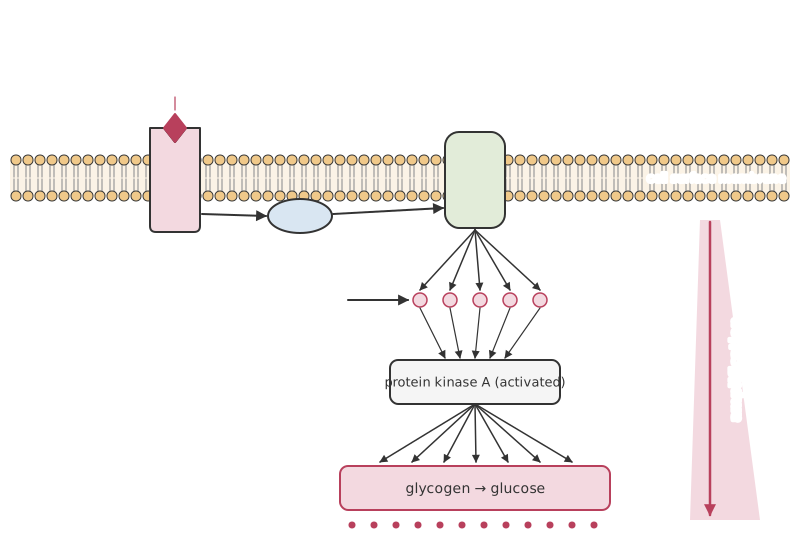
2. Binding changes the shape of the receptor, which activates a G protein on the inner side of the membrane.
3. The G protein activates the enzyme adenylyl cyclase (also called adenyl cyclase) in the membrane.
4. Adenylyl cyclase converts ATP into cyclic AMP (cAMP). cAMP is the second messenger.
5. cAMP activates protein kinase A, which starts a cascade of reactions by phosphorylating and activating other enzymes.
6. The final enzymes break down glycogen into glucose (glycogenolysis). The glucose leaves the cell and raises blood glucose.