Mammals coordinate their responses in two ways: the nervous system and the endocrine (hormonal) system. Chemical control uses hormones.A hormone is a chemical messenger secreted by an endocrine gland directly into the blood. It is carried all around the body but only affects target cells, which have receptors with a shape complementary to that hormone.Hormones can be grouped by how they act on target cells.Peptide and protein hormones (and amine hormones such as adrenaline), for example insulin, glucagon and ADH, are water soluble and cannot pass through the phospholipid bilayer. They bind to receptors on the cell surface membrane and act through a second messenger inside the cell.Steroid hormones, for example oestrogen, testosterone and cortisol, are lipid soluble. They diffuse through the cell surface membrane and bind to receptors in the cytoplasm or nucleus. The hormone-receptor complex acts as a transcription factor, switching genes on or off.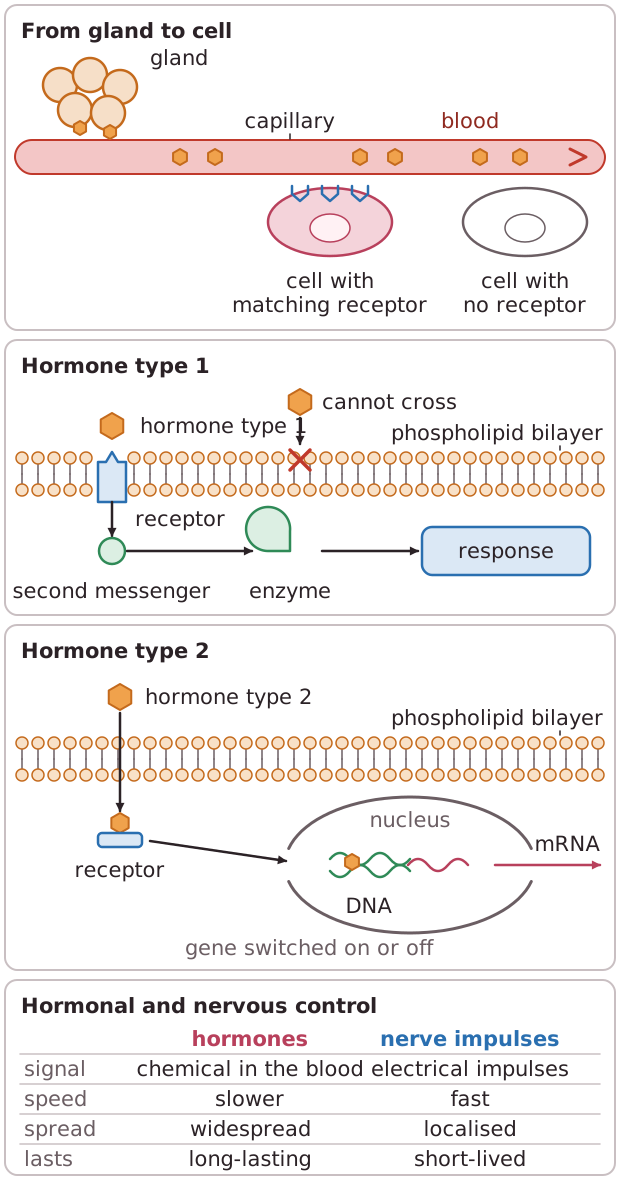 Hormonal and nervous control comparedHormones: a chemical signal carried in the blood; slower to act; effects can be widespread and long-lasting.Nerves: electrical impulses along neurones, with chemical transmission at synapses; very fast; effects are localised and short-lived.Hormones suit long-term changes such as growth, development and the menstrual cycle, and keeping variables such as blood glucose constant. After they have acted, hormones are broken down, mainly in the liver, so their effects do not last indefinitely.