Negative feedback is a mechanism in which a change from the set point triggers a response that reverses the change, bringing the variable back towards the set point. It is the basis of almost all homeostatic control.Once the variable returns to the set point, the stimulus is removed and the corrective response is switched off. The variable therefore fluctuates slightly above and below the set point rather than staying perfectly fixed.Example: body temperatureIf core temperature rises above about 37 °C, thermoreceptors in the hypothalamus detect the rise. The hypothalamus triggers responses that lose heat: sweating, vasodilation of the arterioles supplying skin capillaries, and flattening of hairs. Temperature falls back towards 37 °C.If core temperature falls, the hypothalamus triggers responses that conserve and generate heat: vasoconstriction of skin arterioles, shivering, hairs raised by the erector muscles, and an increased metabolic rate. Temperature rises back towards 37 °C.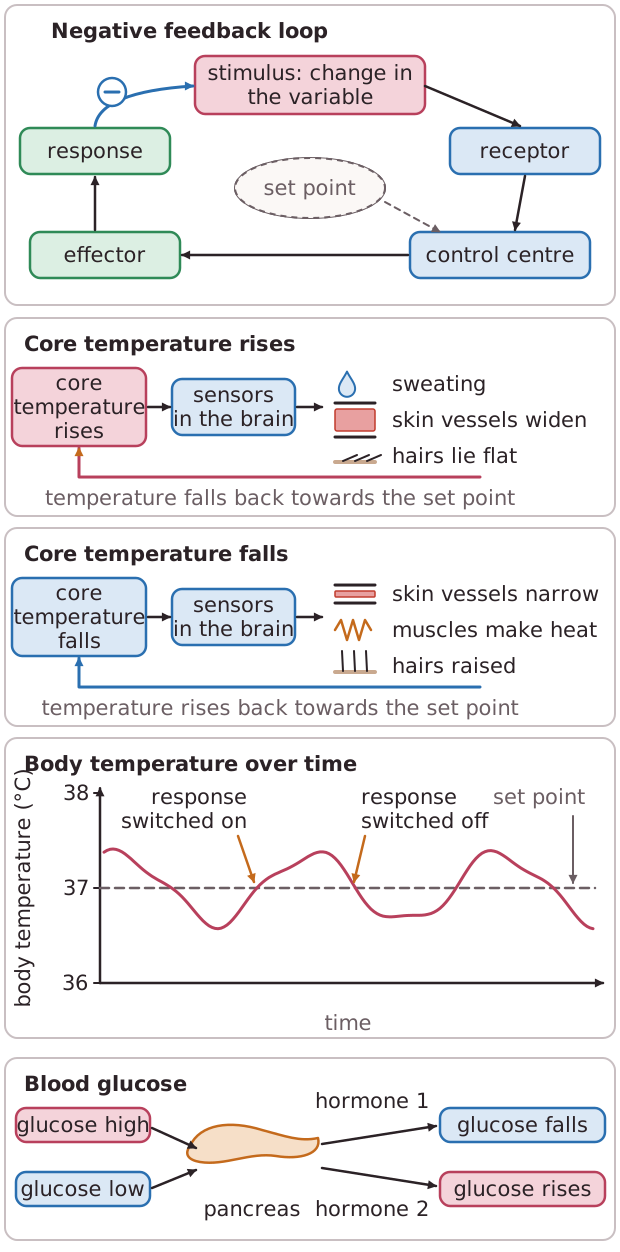 Example: blood glucoseA rise in blood glucose after a meal is detected by cells in the islets of Langerhans, which secrete insulin. Cells take up more glucose and the liver converts glucose to glycogen, so blood glucose falls. A fall in blood glucose causes glucagon to be secreted, which raises it.Negative feedback has two benefits:- it keeps conditions within narrow limits, so enzymes and cells work efficiently;
- separate mechanisms for a rise and a fall allow a faster, more precise return to the set point.
Example: blood glucoseA rise in blood glucose after a meal is detected by cells in the islets of Langerhans, which secrete insulin. Cells take up more glucose and the liver converts glucose to glycogen, so blood glucose falls. A fall in blood glucose causes glucagon to be secreted, which raises it.Negative feedback has two benefits:- it keeps conditions within narrow limits, so enzymes and cells work efficiently;- separate mechanisms for a rise and a fall allow a faster, more precise return to the set point.