The pituitary gland is a pea-sized gland at the base of the brain, attached to the hypothalamus by a stalk. It is often called the 'master gland' because many of its hormones control other endocrine glands. It has two parts that work in different ways.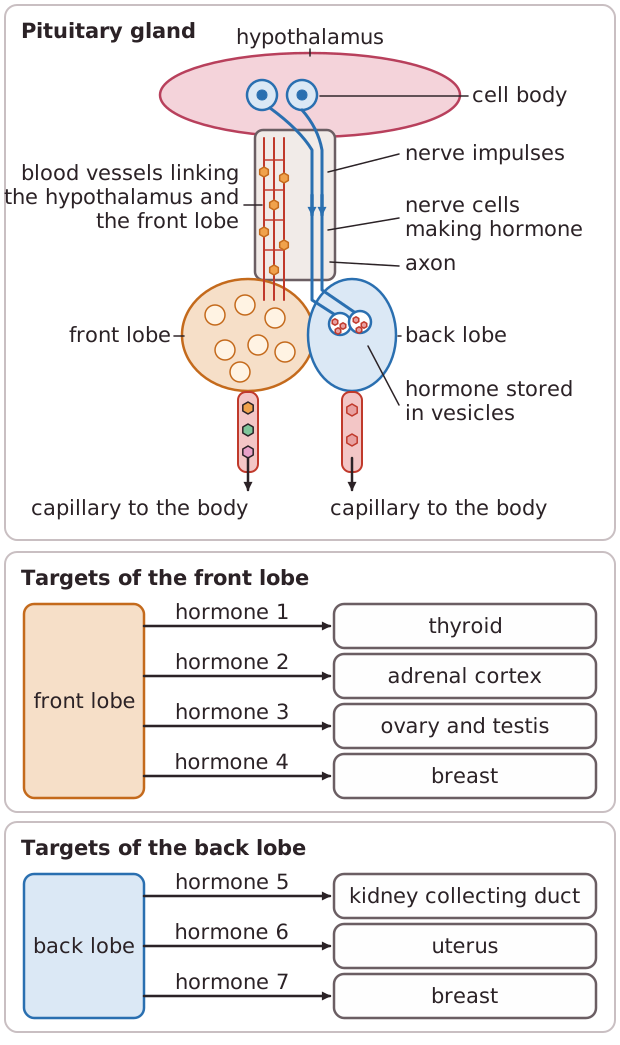 Anterior pituitaryThe anterior pituitary is glandular tissue that makes and secretes its own hormones. It is linked to the hypothalamus by a network of blood vessels (a portal system). The hypothalamus secretes releasing hormones into these vessels, and these control which hormones the anterior pituitary releases. Its hormones include:- TSH (thyroid-stimulating hormone): stimulates the thyroid to release thyroxine;
- ACTH: stimulates the adrenal cortex to release cortisol;
- FSH and LH: control the ovaries and testes;
- growth hormone: stimulates growth;
- prolactin: stimulates milk production.Posterior pituitaryThe posterior pituitary is nervous tissue and does not make hormones. ADH and oxytocin are made in the cell bodies of neurosecretory cells in the hypothalamus. They pass down the axons of these cells to the posterior pituitary, where they are stored. When the neurosecretory cells are stimulated, nerve impulses cause the hormones to be released into the blood.- ADH: increases the permeability of the collecting ducts in the kidney to water, so more water is reabsorbed;
- oxytocin: causes contraction of the uterus during birth and the release of milk during breastfeeding.
Anterior pituitaryThe anterior pituitary is glandular tissue that makes and secretes its own hormones. It is linked to the hypothalamus by a network of blood vessels (a portal system). The hypothalamus secretes releasing hormones into these vessels, and these control which hormones the anterior pituitary releases. Its hormones include:- TSH (thyroid-stimulating hormone): stimulates the thyroid to release thyroxine;- ACTH: stimulates the adrenal cortex to release cortisol;
- FSH and LH: control the ovaries and testes;
- growth hormone: stimulates growth;
- prolactin: stimulates milk production.Posterior pituitaryThe posterior pituitary is nervous tissue and does not make hormones. ADH and oxytocin are made in the cell bodies of neurosecretory cells in the hypothalamus. They pass down the axons of these cells to the posterior pituitary, where they are stored. When the neurosecretory cells are stimulated, nerve impulses cause the hormones to be released into the blood.- ADH: increases the permeability of the collecting ducts in the kidney to water, so more water is reabsorbed;
- oxytocin: causes contraction of the uterus during birth and the release of milk during breastfeeding.