Pressure is the force acting on each unit of area in contact. It is calculated using pressure = force ÷ area, written p = F ÷ A. With force in newtons (N) and area in square metres (m2), pressure is in pascals (Pa), where 1 Pa = 1 N/m2, which is one newton per square metre. For example, a force of 190 N spread over 0.5 m2 gives 190 ÷ 0.5 = 380 Pa. The equation can be rearranged to F = p × A.
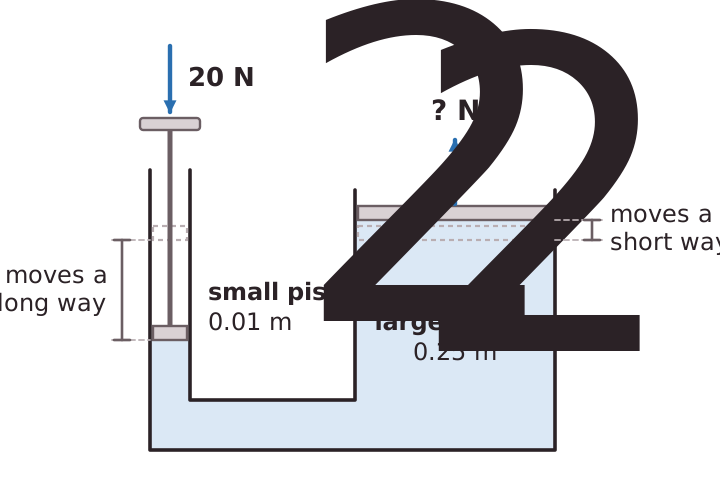
A simple hydraulic system has two pistons joined by a liquid. A liquid is incompressible, which means it cannot be squeezed into a smaller volume. A force on the small piston creates pressure in the liquid, and this pressure is transmitted through the liquid so it is the same at the large piston.
Suppose 240 N acts on a small piston of area 0.02 m2. The pressure is 240 ÷ 0.02 = 12000 Pa. The same pressure acts on a large piston of area 0.125 m2, so the force on it is 12000 × 0.125 = 1500 N.
The hydraulic system is a force multiplier because the large piston has a larger area. The force is multiplied by the ratio of the areas. The small piston moves a long way for the large piston to move a short way.