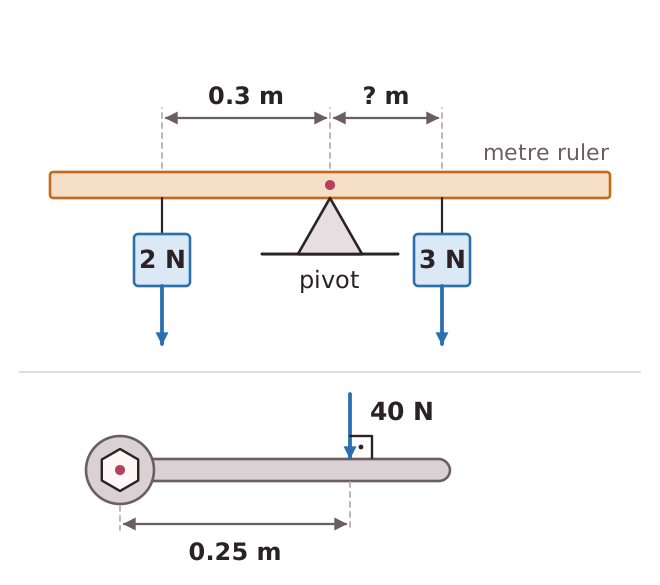
The moment of a force is its turning effect about a pivot. It is calculated with:
moment (Nm) = force (N) × distance (m), or M = F d
The distance is the perpendicular distance from the pivot to the line of the force, measured at right angles to the force. A 24 N force acting 0.5 m from a pivot has a moment of 24 × 0.5 = 12 Nm. Doubling the force or doubling the distance doubles the moment.
When an object is balanced and not turning, the total clockwise moment equals the total anticlockwise moment. This is the principle of moments. For example, a 4 N weight hung 0.5 m left of the pivot of a ruler gives an anticlockwise moment of 2 Nm. A 5 N weight on the right balances it at 2 ÷ 5 = 0.4 m from the pivot.
You can investigate this with a metre ruler balanced on a pivot, hanging masses at different positions, and adjusting them until the ruler stays level. The clockwise and anticlockwise moments should then be equal.