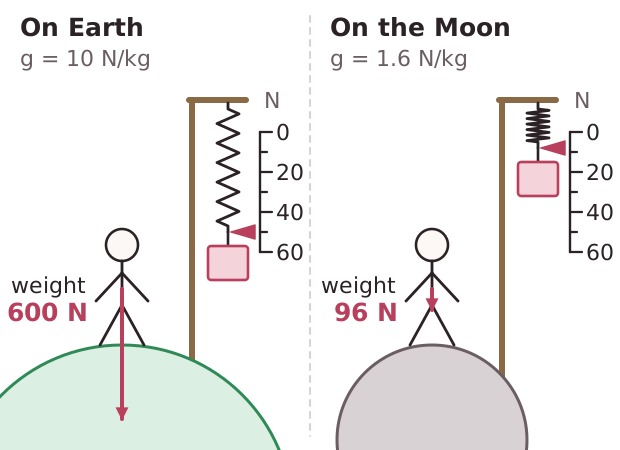
The weight of an object is the force acting on it because of gravity. It is a force, so it is measured in newtons (N), using a newton meter. A newton meter is a calibrated spring balance: the heavier the object, the more the spring stretches and the larger the reading.
Mass is different. Mass is the amount of matter in an object, measured in kilograms (kg), and it stays the same wherever the object is. Weight depends on the gravitational field strength, g, where the object is. The two are linked by the equation:
weight (N) = mass (kg) × gravitational field strength (N/kg), or W = m g
Weight is directly proportional to mass, so doubling the mass doubles the weight. A person of mass 60 kg has a weight of 600 N on Earth, where g is 10 N/kg. On the Moon, where g is 1.6 N/kg, their weight is 96 N, which is less, but their mass is still 60 kg.