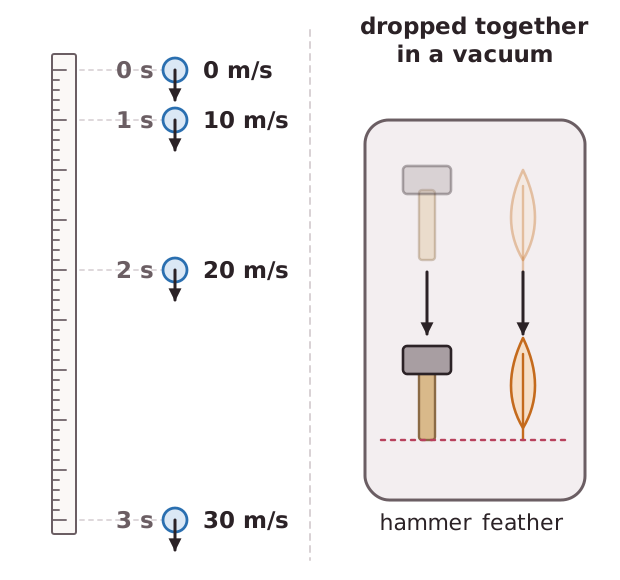
An object is in free fall when the only force acting on it is its weight, so it accelerates downwards. Near the Earth's surface the acceleration of an object in free fall is 10 m/s2. This is the same number as the gravitational field strength, 10 N/kg, so g can be written in either unit.
This means the speed of a falling object increases by 10 m/s every second: after 1 s it is falling at 10 m/s, after 2 s at 20 m/s, and after 3 s at 30 m/s.
A heavier object has a larger weight, but it also has a larger mass, so it is harder to accelerate. The two effects cancel, so every object in free fall has the same acceleration, whatever its mass. A hammer and a feather dropped on the Moon, where there is no air, hit the ground together. On Earth a feather falls slowly only because of air resistance, which is a second force acting upwards.