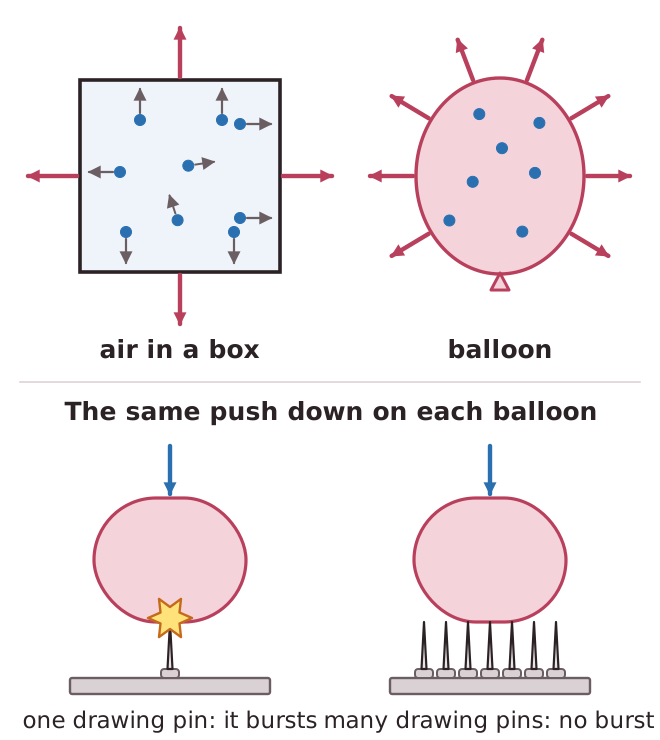
A fluid is a liquid or a gas. The particles in a fluid are free to move, so they are always colliding with any surface in contact with the fluid. Each collision exerts a tiny force on the surface.
There are so many collisions every second that the tiny forces add up to a steady net force on the surface. This is what we mean by the pressure of a fluid. The net force always acts at right angles to the surface, whatever the direction or shape of the surface. This is why a balloon is pushed outwards on all sides by the air inside it.
The same happens in a liquid such as water. The liquid pushes at right angles on the sides and base of its container, and on anything placed in it.
A simple demonstration uses a balloon pushed onto drawing pins. With one drawing pin the force is concentrated on a tiny area and the balloon bursts. With many drawing pins and the same force, the force is spread over a larger area, so the balloon does not burst.