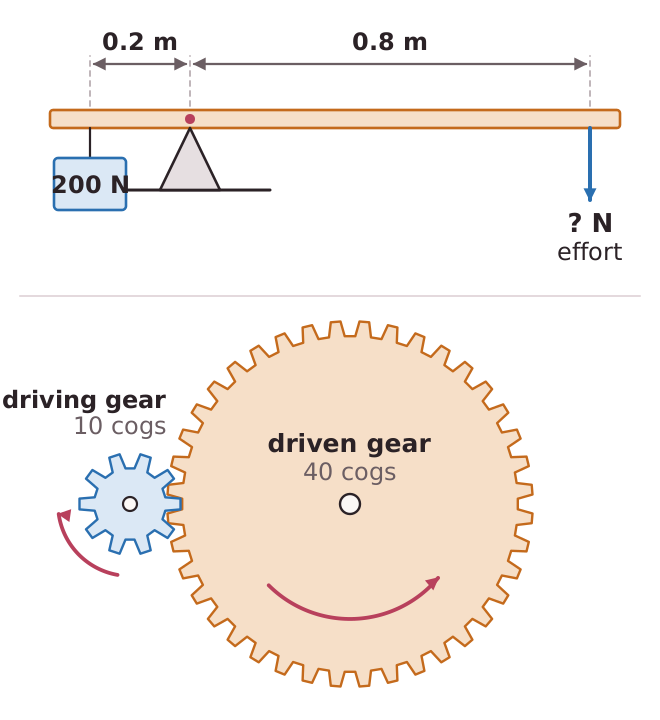
A lever is a rigid bar that turns about a fixed point called the pivot. A force applied to the bar, called the effort, has a turning effect about the pivot. This turning effect is the moment of the force, which is the force multiplied by its perpendicular distance from the pivot. The lever transmits the turning effect to the load at the other end of the bar.
A lever works as a force multiplier when the effort is applied further from the pivot than the load. Suppose the effort is 1.8 m from the pivot and the load is 0.3 m from it. The lever balances when the moments are equal, so a 150 N load gives 150 × 0.3 = 45 N m, and the effort needed is 45 ÷ 1.8 = 25 N. A small effort balances a large load, but the effort must move through a greater distance than the load.
Gears are wheels with teeth that interlock, so turning one gear (the driving gear) makes the next gear (the driven gear) turn. Neighbouring gears turn in the opposite direction. The ratio of the number of teeth on the two gears is the gear ratio, and it decides how the turning effect is changed.
If a driving gear with 12 teeth turns a driven gear with 36 teeth, the ratio is 3 : 1. The driven gear turns 3 times more slowly, but the moment it transmits is 3 times larger. A small gear driving a large gear is therefore a force multiplier. If a large gear drives a small one, the small gear turns faster but transmits a smaller moment. In both cases we ignore friction.