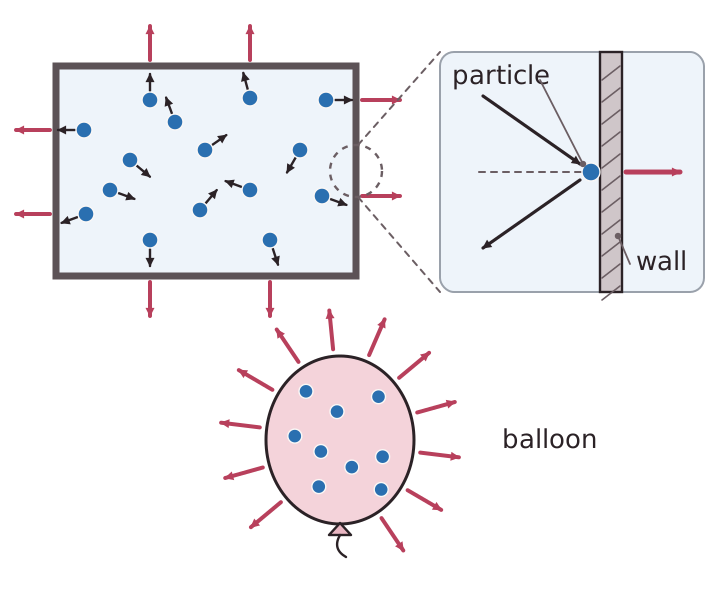
A fluid is a liquid or a gas, and its particles are always moving randomly. When a particle hits a surface it bounces off, and the collision pushes on the surface. Billions of particles colliding with a surface every second add up to a steady force on it. So the pressure in a fluid causes a force on any surface it touches, whether that is the wall of a container or an object placed in the fluid.
Particles bounce off in all directions, but on average the sideways pushes along the surface cancel out. What is left is a push at right angles to the surface. Right angles is what a physicist means by normal, so the force from fluid pressure is always normal to the surface, never along it. At a point in a fluid the pressure acts in all directions.
You can see this if you make holes in the side of a bottle of water. At each hole the water starts out moving at right angles to the wall of the bottle. A balloon shows it too: the air inside pushes outwards on every part of the rubber, at right angles to it, which is why a balloon swells into a round shape.