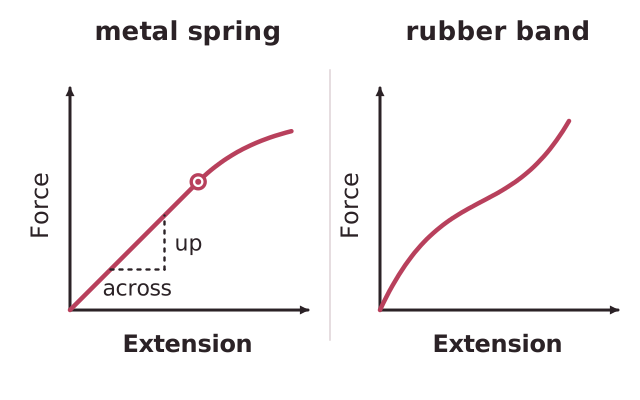
If you plot force on the vertical axis against extension on the horizontal axis, the shape of the graph shows how the object behaves. A linear relationship gives a straight line through the origin. The force is directly proportional to the extension, so doubling the force doubles the extension. For example, if 2 N gives 0.04 m, then 4 N gives 0.08 m and 6 N gives 0.12 m.
The gradient of a straight force-extension graph is force ÷ extension, which is the spring constant. A steeper gradient means a stiffer spring. A metal spring is linear up to its limit of proportionality.
A non-linear relationship gives a curve. The force is not proportional to the extension, so doubling the force does not double the extension, and F = k × x cannot be used. A metal spring stretched beyond its limit of proportionality gives a graph that bends into a curve. A rubber band gives a curve even for small forces.
A graph that is a curve does not always mean the object is permanently deformed. That depends on whether it returns to its original shape when the force is removed.