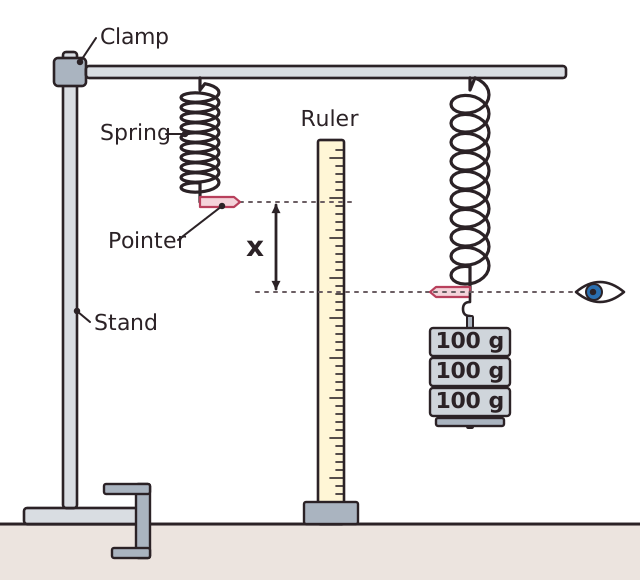
Aim: to investigate how the extension of a spring depends on the force applied, and to find the work done. Clamp the spring from a stand with a ruler held vertically beside it and a pointer fixed to the bottom of the spring. Read the original length with no masses attached.
Method: hang a 100 g mass on the spring, which adds a force of about 1 N. Wait for the spring to stop bouncing, then read the new length with your eye level with the pointer to avoid parallax error. Add another mass and repeat, for about five or six masses. Extension = new length minus original length. The independent variable is the force (the weight added), the dependent variable is the extension, and the same spring and ruler are used throughout. Take care not to go beyond the limit of proportionality.
Results: plot force on the vertical axis against extension on the horizontal axis. Below the limit of proportionality you get a straight line through the origin. The gradient is the spring constant. The work done in stretching is the area under the graph, which is 0.5 × force × extension for a straight line. For example, 5 N giving an extension of 0.04 m gives 0.5 × 5 × 0.04 = 0.1 J. This matches 0.5 × k × x2.
Safety: wear eye protection in case the spring snaps, weigh down the stand so it cannot tip, and keep your feet clear of falling masses.