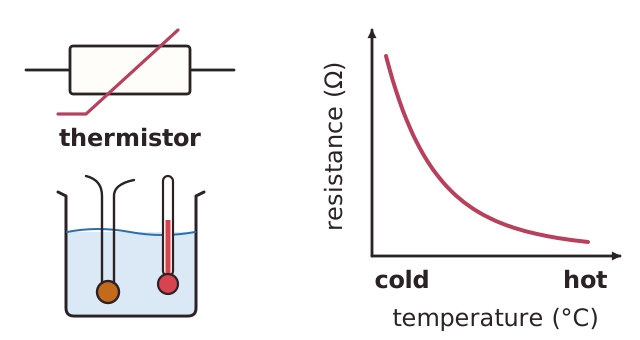
A thermistor is a resistor whose resistance depends on its temperature. At GCSE we use the negative temperature coefficient (NTC) type. In an NTC thermistor the resistance decreases as the temperature increases. When it is cold the resistance is high, and when it is hot the resistance is low.
The name tells you the rule: a negative coefficient means that as the temperature goes up, the resistance goes down. With a constant potential difference, a lower resistance means a larger current. For example, with 9 V across a thermistor that has a resistance of 900 Ω at 20 °C, the current is 9 ÷ 900 = 0.01 A. At 80 °C its resistance is 300 Ω, so the current is 9 ÷ 300 = 0.03 A, which is 3 times bigger.
The resistance does not fall in a straight line. It drops quickly at low temperatures and more slowly at high temperatures. Thermistors are used as a temperature sensor in thermostats, fire alarms and electronic thermometers.