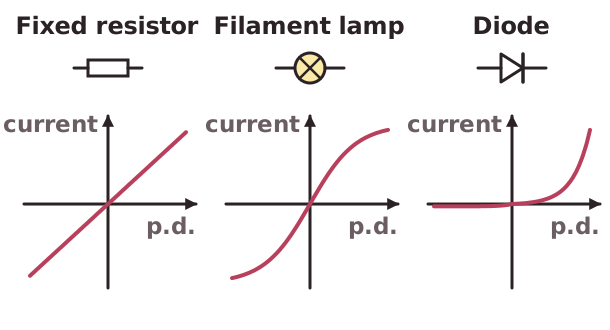
A graph of current against potential difference shows how a component behaves, and its shape tells you how its resistance changes. For a fixed resistor the graph is a straight line through the origin. The current is directly proportional to the potential difference, so the resistance is constant, as long as the temperature stays the same.
For a filament lamp the graph is a curve that gets shallower as the potential difference increases. A larger current makes the thin metal filament much hotter. The metal atoms vibrate more and collide with the moving charges more often, so the resistance increases with current.
A diode lets current pass in one direction only. In the forward direction the current is very small until the potential difference is large enough, then it rises quickly and the resistance falls. In the reverse direction the resistance is very high, so almost no current flows. A diode is therefore used to make sure current can only flow the correct way round a circuit.