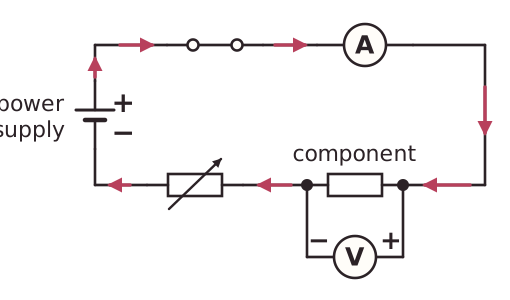
This practical investigates how the current through a component depends on the potential difference across it, for a fixed resistor and then for a filament lamp. The circuit is a power supply, switch and variable resistor in series with the component and an ammeter. A voltmeter is connected in parallel across the component only.
Method: set the variable resistor so that the potential difference across the component is small, close the switch, and record the ammeter and voltmeter readings. Open the switch, change the variable resistor to give a larger potential difference and repeat, collecting at least six pairs of readings. The independent variable is the potential difference, the dependent variable is the current, and the component must stay the same during each run. The switch is opened between readings to stop the component getting hot. Resistance for each pair of readings is found by dividing the potential difference by the current.
Plot a graph of current (on the vertical axis) against potential difference. For the fixed resistor the points lie on a straight line through the origin, so the resistance is constant. For the filament lamp the points form a curve that gets shallower at higher potential difference. This is because the filament gets hotter as the current rises, so its resistance increases.