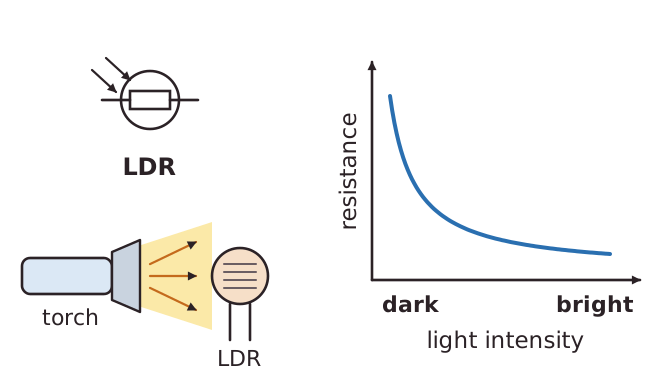
A light-dependent resistor (LDR) is a component whose resistance changes with the light falling on it. In bright light its resistance is low. In the dark its resistance is very high. So the resistance of an LDR decreases as the light intensity increases.
Because current = potential difference ÷ resistance (I = V ÷ R), a lower resistance gives a larger current when the potential difference stays the same. For example, with 12 V across an LDR, a resistance of 100 Ω in bright light gives a current of 12 ÷ 100 = 0.12 A. In the dark the resistance might be 4000 Ω, and the current falls to 12 ÷ 4000 = 0.003 A, which is smaller.
The change is not a straight line: the resistance falls steeply at first and then more slowly as the light gets brighter. LDRs are used in light sensors, for example to switch on street lights automatically when it gets dark.