A progressive wave is an oscillation that travels through a medium, or through a vacuum for electromagnetic waves, and transfers energy from one place to another without transferring matter.As a water wave passes, a floating cork bobs up and down but does not travel along with the wave. Each particle of the medium oscillates about its fixed equilibrium position and passes energy on to the next particle, so the disturbance moves along while the particles stay where they are.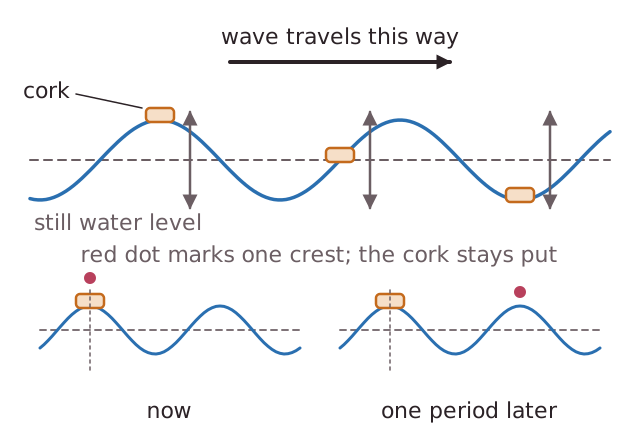 Mechanical waves, such as sound, water waves and waves on a string, need a medium. Electromagnetic waves, such as light and radio waves, are oscillating electric and magnetic fields and can travel through a vacuum, which is how energy from the Sun reaches the Earth.The rate at which a wave carries energy through a surface is described by its intensity, the power per unit area at right angles to the direction the wave travels:
I = P ÷ A Intensity is measured in W m-2. The larger the amplitude of a wave, the more energy it carries: intensity is proportional to amplitude squared.Worked exampleA solar panel of area 1.5 m2 faces the Sun, and sunlight of intensity 800 W m-2 falls on it at right angles.P = I × A = 800 × 1.5 = 1200 WIf the amplitude of a wave doubles, its intensity becomes 22 = 4 times larger.
Mechanical waves, such as sound, water waves and waves on a string, need a medium. Electromagnetic waves, such as light and radio waves, are oscillating electric and magnetic fields and can travel through a vacuum, which is how energy from the Sun reaches the Earth.The rate at which a wave carries energy through a surface is described by its intensity, the power per unit area at right angles to the direction the wave travels: