 BRAINCAKE
Pulse Echo Measurements
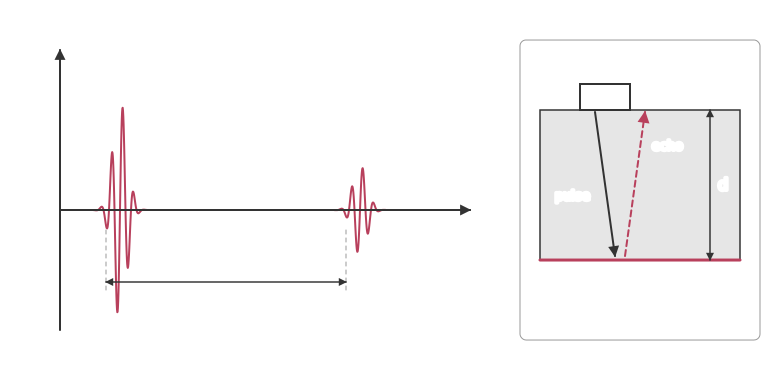
In pulse-echo techniques a short pulse of waves is sent out, reflects from a boundary, and the reflected pulse (the echo) is detected, often by the same transducer that sent it. The pulse travels to the reflector and back, so if the echo returns a time t after the pulse was sent, the distance d to the reflector is given by
Uses include medical ultrasound scanning, sonar for measuring the depth of the sea, radar for tracking aircraft, and detecting cracks inside metal parts. The pulses are often displayed on an oscilloscope, where the time base converts the horizontal gap between the transmitted pulse and the echo into a time.
Sign in free to see the rest of this lesson, the R.E.C.I.P.E. recall steps and the quiz
BrainCake is free. Make an account in seconds and pick up where this page stops.
Key terms in this lesson
- transducer
- A device that converts a signal from one form of energy into another, for example electrical oscillations into ultrasound.
- wavelength
- The distance between two adjacent points on a wave that are in phase, such as one crest to the next.
More in Waves
- Energy Transfer by Waves
- Wave Measurements
- Investigating the Speed of Sound
- Transverse and Longitudinal Waves
- Earthquakes
- Phase and Phase Difference
- Superposition
- Interference
All 22 lessons in Waves · All Edexcel AS-level Physics topics