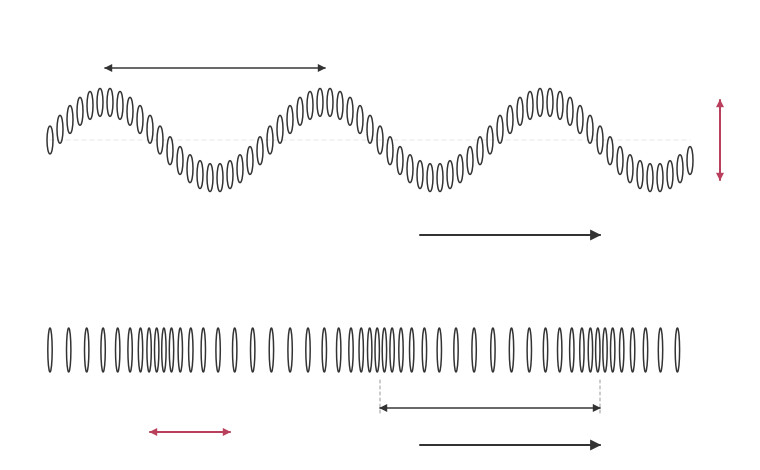
Waves are classified by the direction of the oscillations compared with the direction in which the wave transfers energy.In a transverse wave the oscillations are perpendicular to the direction of energy transfer. Examples are waves on a string, ripples on water and all electromagnetic waves, in which the electric and magnetic fields oscillate at right angles to the direction of travel. A transverse wave has crests and troughs.In a longitudinal wave the oscillations are parallel to the direction of energy transfer. Sound is the main example. The particles move back and forth along the direction of travel, forming compressions, where they are closer together than normal and the pressure is higher, and rarefactions, where they are further apart and the pressure is lower. Sound needs a medium, so it cannot travel through a vacuum.