Skip to content

Wave Measurements

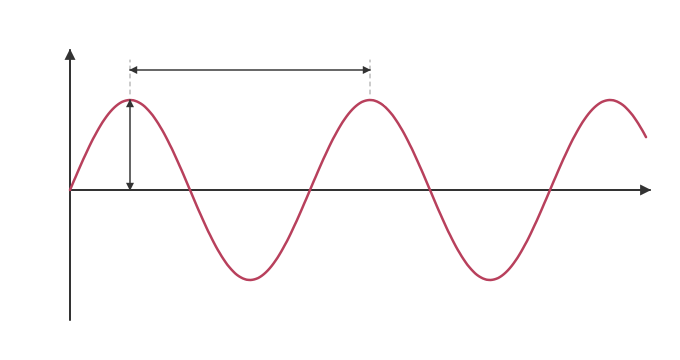
These quantities describe a wave:Displacement: the distance of a point on the wave from its equilibrium position, in a stated direction.Amplitude (A): the maximum displacement from the equilibrium position.Wavelength (λ): the distance between two adjacent crests (or two adjacent troughs).Period (T): the time taken for one complete oscillation.Frequency (f): the number of complete oscillations per second, measured in hertz (Hz).
f = 1 ÷ T
Wave speed (v): the distance the wave travels per unit time. In one period the wave moves forward one wavelength, so
v = fλ
On a displacement-distance graph, the wavelength is read along the horizontal axis between repeating points. On a displacement-time graph for one point, the same repeat gives the period instead. Amplitude is measured from the centre line to a crest, not from trough to crest.Worked exampleA sound wave has a period of 2.5 ms and a wavelength of 0.85 m.f = 1 ÷ T = 1 ÷ (2.5 × 10⁻³) = 400 Hzv = fλ = 400 × 0.85 = 340 m s-1Always convert to SI units (ms to s, cm to m) before substituting.

Read the text

Read the text and highlight anything you think is important. When you go on, the text is hidden and you answer from memory.