Two or more springs are said to be in parallel when they are connected side-by-side so as to act as a single spring.The extension of the combination of springs is their common extension, and the total force is the sum of the forces in the individual springs.keq = k1 + k2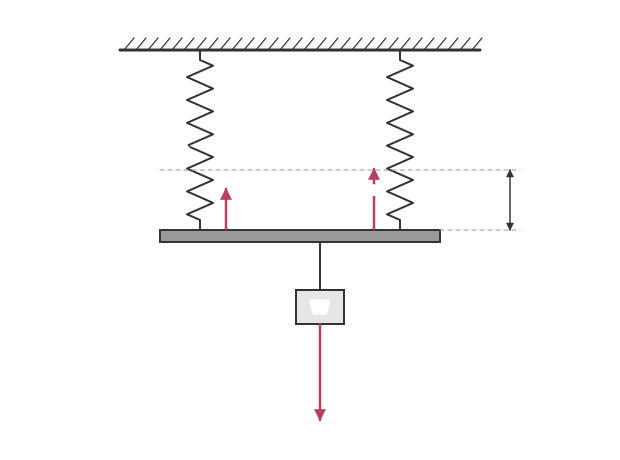
F = F1 + F2 = k1Δx + k2Δx = (k1 + k2)Δx Comparing this with F = keqΔx gives keq = k1 + k2. For more springs, add every spring constant.The combination is stiffer than any single spring, the opposite of springs in series.Worked exampleSprings of stiffness 200 N m-1 and 300 N m-1 are connected in parallel and support a load of 25 N.keq = 200 + 300 = 500 N m-1Δx = F ÷ keq = 25 ÷ 500 = 0.050 mThe forces in the springs are 200 × 0.050 = 10 N and 300 × 0.050 = 15 N, which add up to the 25 N load. The stiffer spring carries the larger share.Two identical springs in parallel have twice the stiffness of one spring, so under the same load they extend half as much.