The speed of sound in air can be measured with a signal generator, a loudspeaker, a microphone and a two-beam (dual-trace) oscilloscope.Connect the signal generator to the loudspeaker and also to channel 1 of the oscilloscope, so channel 1 shows the signal being sent out. Connect the microphone to channel 2. Set a frequency of a few kilohertz, for example 2.0 kHz, read from the signal generator.Place the microphone in front of the loudspeaker and move it along a metre rule until the two traces are in phase, with their peaks lined up. Record its position. Then slowly move the microphone away until the traces are in phase again: it has moved one wavelength.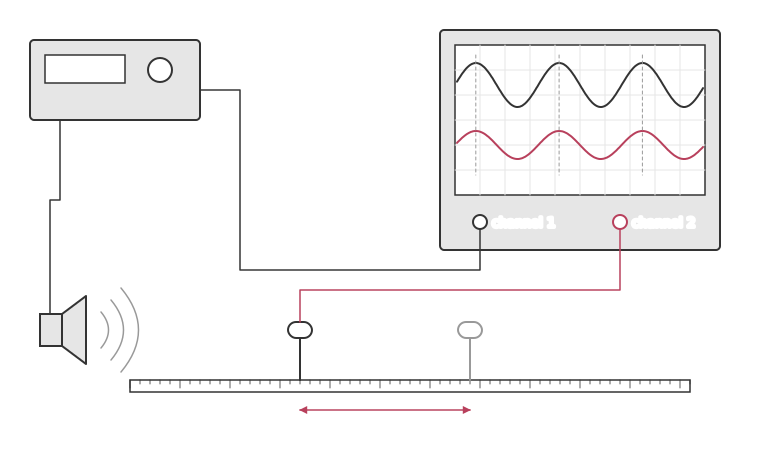
v = fλ Worked exampleAt 2.0 kHz the microphone moves 0.85 m while the traces come back into phase five times.λ = 0.85 ÷ 5 = 0.17 mv = fλ = 2000 × 0.17 = 340 m s-1Repeating at several frequencies and plotting λ against 1/f gives a straight line through the origin whose gradient is the speed of sound.Reflections from walls and the bench can distort the trace, so work away from hard surfaces. The speed of sound depends on temperature, so record the room temperature.