When two or more waves meet at a point, they do not bounce off each other. Instead they overlap, and the principle of superposition tells you what happens:When two or more waves meet, the resultant displacement at any point is the vector sum of the displacements of the individual waves at that point.Displacements above the equilibrium position count as positive and those below count as negative, so you must add them with their signs.Constructive superposition: a crest meets a crest (or a trough meets a trough). The displacements add to give a bigger resultant. Two crests of 3 cm give a resultant of 6 cm.Destructive superposition: a crest meets a trough. The displacements partly or completely cancel. A crest of 3 cm and a trough of 3 cm give a resultant of zero at that instant.
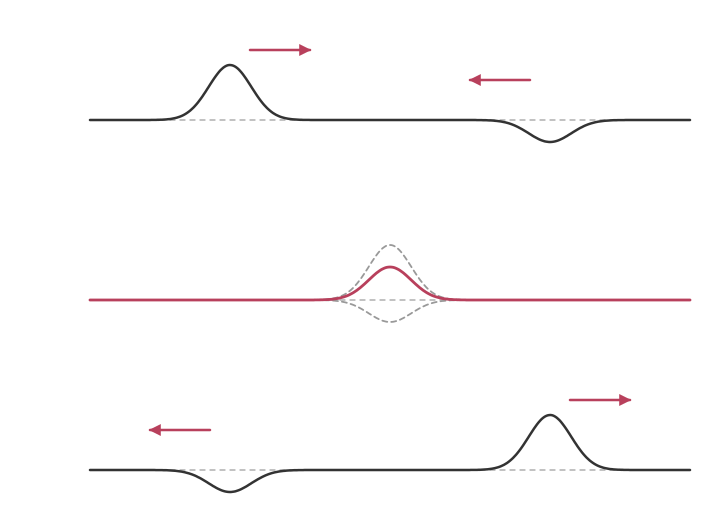
Worked example: a pulse of displacement +5 cm meets a pulse of displacement −2 cm on a rope. While they overlap, the resultant displacement is +5 + (−2) = +3 cm.After the waves have passed through each other, each one continues unchanged, with the same shape, amplitude and speed it had before. Superposition only affects the displacement while the waves overlap.Superposition applies to all types of wave: sound, light, water waves and waves on strings. It is the idea behind interference and stationary waves.
Superposition
Read the text
Read the text and highlight anything you think is important. When you go on, the text is hidden and you answer from memory.
Specification: Edexcel Physics (8PH0), AS-level, Topic 5: Waves and Particle Nature of Light. Topic: Waves.
More in Waves
- Pulse Echo Measurements
- Transverse and Longitudinal Waves
- Earthquakes
- Phase and Phase Difference
- Interference
- Progressive Waves
- Stationary Waves
- Demonstrating Stationary Waves
All 22 lessons in Waves · All Edexcel AS-level Physics topics