The position of the image formed by a thin lens can be calculated with the lens equation:1/u + 1/v = 1/f u is the distance from the lens to the object, v is the distance from the lens to the image, and f is the focal length. All three must be in the same units.Edexcel uses the real is positive sign convention:
Distances to real objects and real images are positive.
Distances to virtual images are negative.
A converging lens has positive f; a diverging lens has negative f.So if your answer for v is negative, the image is virtual and on the same side of the lens as the object.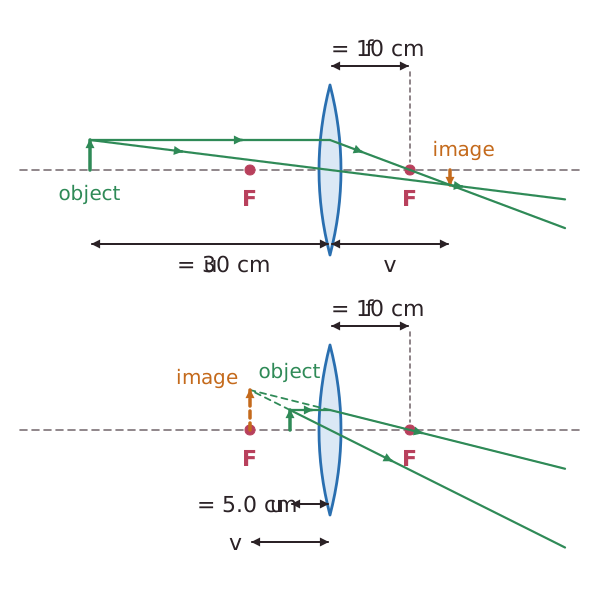 Worked example 1: an object is 30 cm from a convex lens of focal length 10 cm.
1/v = 1/10 − 1/30 = 3/30 − 1/30 = 2/30, so v = +15 cm. The image is real, 15 cm on the far side of the lens.Worked example 2: an object is 5.0 cm from the same lens.
1/v = 1/10 − 1/5.0 = −1/10, so v = −10 cm. The image is virtual, 10 cm from the lens on the object side (a magnifying glass).Worked example 3: an object is 20 cm from a concave lens with f = −20 cm.
1/v = −1/20 − 1/20 = −2/20, so v = −10 cm. Virtual, as always for a concave lens.Always work out 1/v first and take the reciprocal at the end. Check your answer against a quick ray diagram.
Distances to real objects and real images are positive.
Distances to virtual images are negative.
A converging lens has positive f; a diverging lens has negative f.So if your answer for v is negative, the image is virtual and on the same side of the lens as the object.
Worked example 1: an object is 30 cm from a convex lens of focal length 10 cm.1/v = 1/10 − 1/30 = 3/30 − 1/30 = 2/30, so v = +15 cm. The image is real, 15 cm on the far side of the lens.Worked example 2: an object is 5.0 cm from the same lens.
1/v = 1/10 − 1/5.0 = −1/10, so v = −10 cm. The image is virtual, 10 cm from the lens on the object side (a magnifying glass).Worked example 3: an object is 20 cm from a concave lens with f = −20 cm.
1/v = −1/20 − 1/20 = −2/20, so v = −10 cm. Virtual, as always for a concave lens.Always work out 1/v first and take the reciprocal at the end. Check your answer against a quick ray diagram.