 BRAINCAKE
IV Graphs
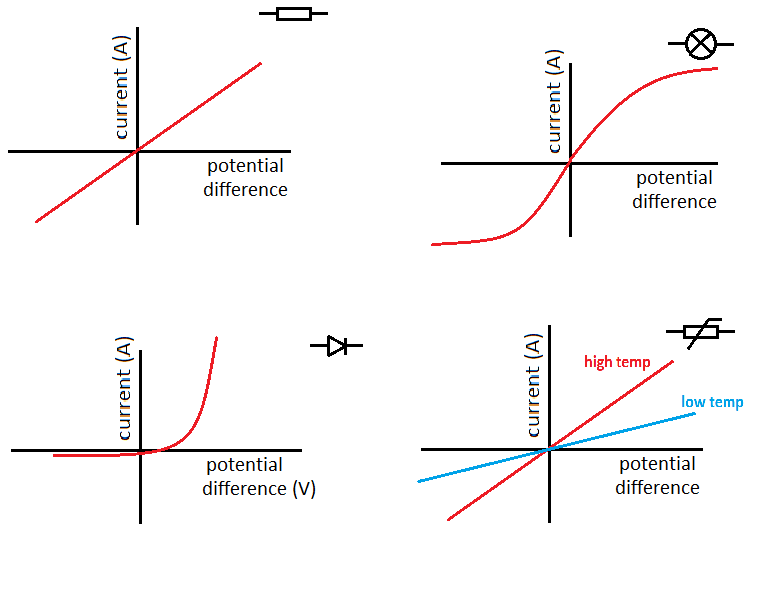
A current-potential difference graph, or IV graph, shows how the current through a component changes as the p.d. across it is varied. The p.d. is reversed to find how the component behaves in both directions.
An ohmic conductor, such as a fixed resistor at constant temperature, gives a straight line through the origin. Its resistance is constant.
A filament lamp gives a curve that becomes flatter at higher p.d. As the current increases, the filament gets hotter and its resistance increases, so the current rises less for each extra volt.
Sign in free to see the rest of this lesson, the R.E.C.I.P.E. recall steps and the quiz
BrainCake is free. Make an account in seconds and pick up where this page stops.
Key terms in this lesson
- Thermistor
- A component whose resistance decreases markedly as its temperature increases, because more charge carriers become available.
- Light dependent resistor
- A component whose resistance decreases as the intensity of light falling on it increases.
- Diode
- A semiconductor component that allows current to flow easily in one direction, forward bias, but has a very high resistance in the other, reverse bias.
- Threshold voltage
- The minimum forward potential difference across a diode, about 0.6V for silicon, needed before it conducts appreciably.
More in Electric Current
- Resistivity
- Superconductivity
- Electronic Components
- Investigating the Characteristics of Components
- Fixed Resistors
- Filament Lamp
- Thermistors and Light Dependent Resistors
- Diodes
All 20 lessons in Electric Current · All AQA AS-level Physics topics