Superconductor materials have zero resistivity below a critical temperature e.g. about 134K (-139°C) for compounds containing mercury, barium, calcium, copper and oxygen.They are used to make high power electromagnets.Unlike an ordinary metallic conductor, whose resistance decreases gradually as its temperature is lowered, even down to near absolute zero, a superconductor has a characteristic critical temperature below which the resistance drops abruptly to zero.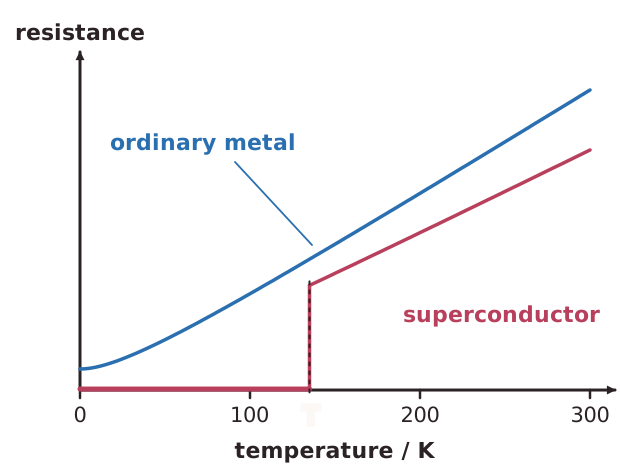 Superconductors can be made from pure metals, alloys or ceramics like cuprates.